 I saw Francesca Segal in conversation with Amanda Craig at the Jewish Book Festival in March 2018 and was immediately intrigued when she said she was writing a non-fiction book about the premature birth of her identical twin daughters ten weeks before their due date. Published in the UK this week, ‘Mother Ship’ is presented as a diary of the 56 fraught days the babies (initially known as A-lette and B-lette) spent in the neonatal intensive care unit (NICU) in the weeks leading up to Christmas 2015. Continue reading
Tag Archives: Book Review
Mother Ship by Francesca Segal
Filed under Books
The Capital by Robert Menasse
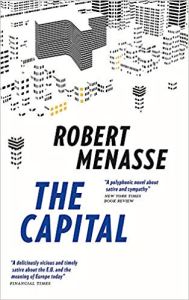 I am sure there are many books of various genres currently being written about Britain leaving the European Union right now, but maybe not so many which satirise the complex bureaucracy of the EU itself. However, Robert Menasse’s novel addresses the latter topic, won the German Book Prize in 2017 and has now been translated into English by Jamie Bulloch. Set in Brussels where the headquarters of the main EU institutions are located, the Directorate-General for Culture has been tasked with organising a celebration to mark the 50th anniversary of the European Commission. Martin Susman, the Austrian PA to ambitious Greek Cypriot Fenia Xenopoulou suggests putting Auschwitz survivors at the centre of the jubilee event. Meanwhile, the complexities of European agricultural policy, trade deals and the cost of pork exports to China cause headaches and petty power games galore and Inspector Brunfaut is investigating the death of an unnamed man in the Hotel Atlas. Oh, and a pig is running wild in the streets of Brussels too. Continue reading
Filed under Books
Saltwater by Jessica Andrews
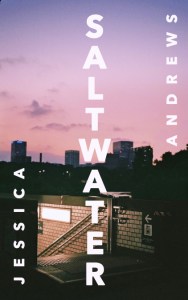 You would be forgiven for thinking that I had pretty much abandoned fiction based on my blog content over the past few months, but I have started reading more novels again recently. Some aspects of Jessica Andrews’ debut ‘Saltwater’ reminded me a lot of ‘Sight’ by Jessie Greengrass, particularly in its visceral imagery concerning changing bodies and an emerging sense of self. Based on Andrews’ life so far, it also appears that there is a strong element of autofiction in this coming-of-age story in which Lucy is finding her way in the world from growing up in Sunderland to her student years in London to inheriting a cottage in Donegal from her grandfather after she graduates from university. Continue reading
Filed under Books
Airhead by Emily Maitlis
 Emily Maitlis has been a journalist and broadcaster for over twenty years and is currently the lead presenter of the BBC’s Newsnight programme. Her first book ‘Airhead’ is a collection of her most significant and memorable TV interviews, with an explanation of the planning and thinking behind each one, as well as the build-up and aftermath off camera. Sometimes the interviews are carefully planned and structured in order to tease out the most telling response from the person being grilled. More often than not, though, the most effective and surprising ones are brought about by happy accident such as her encounter with Anthony Scaramucci. Coupled with the constant sense of unpredictability associated with live television (which is more cock-up than conspiracy, according to Maitlis), the subtitle “the imperfect art of making news” is certainly fitting. Continue reading
Filed under Books
The Ten Types of Human by Dexter Dias
 ‘The Ten Types of Human: Who We Are and Who We Can Be’ by Dexter Dias explores the best and worst of human behaviour – how and why people can be utterly selfless and also commit terrible atrocities. Dias is a human rights lawyer and part-time judge who was presented with a case in which a 15-year-old boy died in a young offender institution when three officers restrained him. ‘The Ten Types of Human’ is the result of years of research combining psychology, philosophy and the neuroscience of decision-making in which Dias seeks to explain the factors which led this to happen.
Filed under Books
The Library Book by Susan Orlean
 ‘The Library Book’ by Susan Orlean documents the devastating fire that raged for seven hours at Los Angeles Public Library in April 1986 and destroyed or damaged over one million books. Investigators quickly concluded that the fire was probably an arson attack but the cause has never been solved and the main suspect, Harry Peak, was arrested but never charged. Continue reading
Filed under Books
Can You Tolerate This? by Ashleigh Young
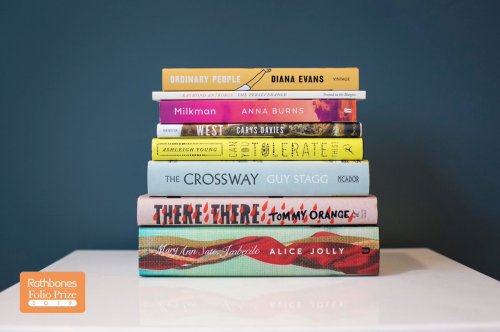
I am championing Ashleigh Young’s collection of essays ‘Can You Tolerate This?’ as part of the Rathbones Folio Prize blog tour today. The eight books on this year’s shortlist include four novels, a novella, two non-fiction books and a collection of poetry whittled down from a list of 80 works published in the UK in 2018 chosen by members of the Folio Academy.
 ‘Can You Tolerate This?’ is Young’s non-fiction debut (she is also a poet) and tackles a diverse range of subjects, mostly leaning towards her own personal experiences of growing up in Te Kuiti in New Zealand as well as a smattering of historical portraits and other topics too. The 20 essays in this collection include her experience of working as the manager at Katherine Mansfield’s birthplace (‘Katherine Would Approve’), Japanese recluses known as hikikomori (‘Sea of Trees’), 19th century French postal worker Ferdinand Cheval (‘Postie’) and her resentment towards a childhood pet (‘Black Dog Book’). However, the main recurring theme in her work is the body, from the short opening essay about a patient with two skeletons (‘Bones’) to musings on her own body hair (‘Wolf Man’) poor eyesight (‘Absolutely Flying’) and yoga and her eating disorder treatment (‘Bikram’s Knee’). Continue reading
Filed under Books
XX by Angela Chadwick
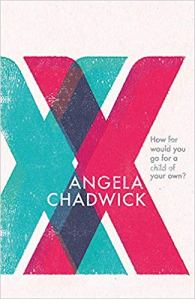 The opening paragraph of ‘XX’ by Angela Chadwick is as good as any to sum up the premise of her debut novel published last year: “After years of controversial research, scientists at Portsmouth University’s Centre for Reproductive Medicine have this morning announced plans to create IVF babies from two women. They’re pushing for a change to the Human Fertilisation and Embryology Act that will make it legal to fertilise an egg with genetic material from a second female.” Lesbian couple Rosie and Jules are quick to take up the opportunity to have a baby of their own through the means of a groundbreaking clinical trial, but a backlash from right-wing movements inevitably creates problems along the way. Continue reading
Filed under Books
Heart: A History by Sandeep Jauhar
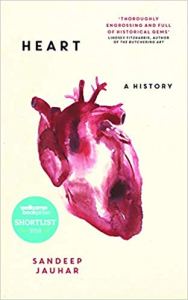 I am taking part in the Wellcome Book Prize blog tour today with a review of ‘Heart: A History’ by Sandeep Jauhar which is the final book I will be shadowing from this year’s shortlist. Jauhar is a cardiologist and director of the Heart Failure Program at Long Island Jewish Medical Center and his third book combines memoir, case studies and the history of cardiology. In the opening pages, he recounts his family history (both of his grandfathers died as a result of sudden cardiac events) and how his own CT angiogram revealed signs of early coronary artery disease. Jauhar’s obsession with this vital and remarkable organ is therefore a very personal one. Continue reading
Filed under Books
Wellcome Book Prize: Mind on Fire and Murmur
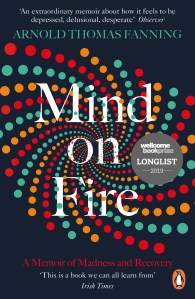 I am approaching the end of shadowing this year’s Wellcome Book Prize, and I have followed two books which explore gender as the central theme (The Trauma Cleaner and Amateur) with two books primarily concerned with mental health. ‘Mind on Fire: A Memoir of Madness and Recovery’ by Arnold Thomas Fanning is a memoir which outlines his experience of bipolar disorder in the late 1990s. Having first suffered from depression at the age of 20 following the death of his mother, he had a breakdown in his late twenties while living in Dublin after quitting his job to concentrate on writing in 1997. He was hospitalised several times and also spent time homeless in London amid periods of mania. The narrative has been pieced together from his own fragmented memories, medical records and interviews with those who were involved at the time. The opening section is a frank stream of consciousness told in the second person while the rest of the narrative is told primarily in the present tense. Continue reading
Filed under Books
Why We Get the Wrong Politicians by Isabel Hardman
 With Parliament still in the grip of deadlock over Brexit, a book with the title ‘Why We Get the Wrong Politicians’ might sound particularly timely. However, even Isabel Hardman admits that the provocative title is slightly misleading. Rather than a populist takedown of lazy and self-serving MPs, her examination of the political class is more sympathetic, as she shows that it tends to be the structural flaws in the system which have caused so much political dysfunction in recent years. Continue reading
Filed under Books
Becoming by Michelle Obama
 ‘Becoming’ by Michelle Obama is already one of the bestselling memoirs of all time selling nearly 10 million copies just four months after it was first published towards the end of 2018. Rebecca, Laura and I optimistically attempted to get tickets for the former First Lady’s sell-out talk with Chimamanda Ngozi Adichie at the Southbank Centre in December along with a mere 44,000 other people. We were, of course, unsuccessful, but I eventually got hold of a library copy of the much talked-about memoir which is split into three parts. “Becoming Me” covers her childhood growing up in the South Side of Chicago, college years at Princeton and Harvard and early legal career. “Becoming Us” begins with her meeting Barack Obama in the late 1980s through to the 2008 presidential election and “Becoming More” which covers the two terms spent at the White House. Continue reading
Filed under Books
Wellcome Book Prize: Amateur and The Trauma Cleaner
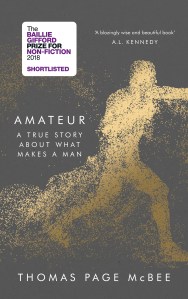 Gender is a notable theme on this year’s Wellcome Book Prize longlist and two of the books shortlisted this year (by the official judges and by the shadow panel) look at the lives and experiences of transgender individuals. ‘Amateur’ by Thomas Page McBee was also shortlisted for the Baillie Gifford Prize for Non-Fiction last year and is an exploration of modern masculinity told through McBee’s training as the first trans man to fight in a charity boxing match at Madison Square Garden. From a childhood dominated by male violence in which he was abused by his stepfather from the age of four, McBee untangles the tricky relationship between masculinity and violence, questioning if aggression is an exclusively “toxic” male trait. Continue reading
Filed under Books
The Wellcome Book Prize 2019 Shortlist
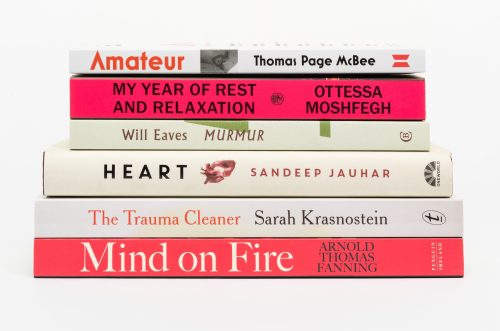
The Wellcome Book Prize shortlist was announced earlier this week and the six titles are:
Murmur by Will Eaves
Mind on Fire by Arnold Thomas Fanning
Heart by Sandeep Jauhar
The Trauma Cleaner by Sarah Krasnostein
Amateur by Thomas Page McBee
My Year of Rest and Relaxation by Ottessa Moshfegh
From what we have read between us so far, the shadow panel has also come up with our own shortlist of seven titles (due to a tie on a couple), four of which overlap with the official shortlist:
Murmur by Will Eaves
This Really Isn’t About You by Jean Hannah Edelstein
Sight by Jessie Greengrass
Heart by Sandeep Jauhar
The Trauma Cleaner by Sarah Krasnostein
Amateur by Thomas Page McBee
Educated by Tara Westover
Continue reading
Filed under Books
Chernobyl by Serhii Plokhy
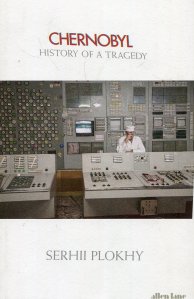 Winner of the Baillie Gifford Prize for Non-Fiction last year, ‘Chernobyl: History of a Tragedy’ by Serhii Plokhy is a comprehensive account of the worst nuclear accident in history. The small Ukrainian city will forever be associated with the explosion which occurred on 26th April 1986 after a failed safety test. It is now a key destination for “disaster tourism”, despite the 30-mile exclusion zone which is still in place around the site of the reactor which will remain unfit for human habitation for 20,000 years. The technical statistics are staggering – the radiation released by the explosion was equivalent to 500 Hiroshima bombs spreading rapidly across Europe – and the human cost of those affected by radiation sickness is incalculable. Continue reading
Filed under Books
Educated by Tara Westover
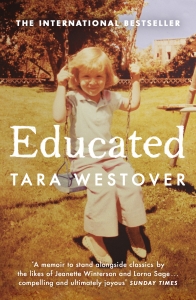 I had heard of ‘Educated’ before it was longlisted for the Wellcome Book Prize but hadn’t considered Tara Westover’s widely acclaimed memoir of her childhood growing up in a Mormon fundamentalist family in rural Idaho as a possible contender. Although not immediately obvious from the title or basic premise of the book, there are numerous connections to the main thematic criteria of the prize related to health. Isolated from mainstream society by radical survivalist parents, Westover and her six older siblings didn’t attend school and the family never saw doctors – even serious incidents like car accidents and third degree burns were treated at home with her mother’s herbal tinctures rather than at hospital. She didn’t receive a birth certificate until she was nine years old and spent most of her time working at her father’s junkyard, later studying independently at home. Continue reading
Filed under Books
Olive Kitteridge by Elizabeth Strout
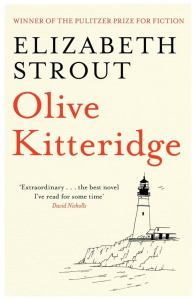 I really enjoyed watching the HBO TV mini-series adaptation of ‘Olive Kitteridge’ last year and have been keen to read the original book by Elizabeth Strout which won the Pulitzer Prize for Fiction in 2009. It is a novel in the form of 13 linked short stories set in the coastal town of Crosby, Maine centred around the life of the eponymous character during late middle age after retiring from her job as a junior high school maths teacher. Her gregarious husband, Richard, is a pharmacist and her son, Christopher, is a podiatrist. However, there are long-standing tensions in the family with Olive seemingly unable to communicate affection towards those closest to her. Continue reading
Filed under Books
The Wellcome Book Prize Longlist 2019
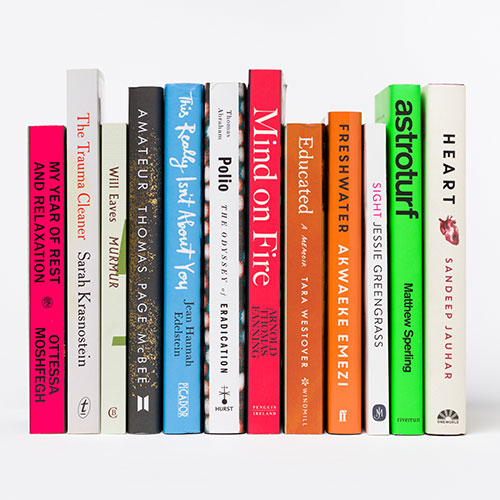
The 12 books longlisted for this year’s Wellcome Book Prize are:
Amateur by Thomas Page McBee
Astroturf by Matthew Sperling
Educated by Tara Westover
Freshwater by Akwaeke Emezi
Heart: A History by Sandeep Jauhar
Mind on Fire by Arnold Thomas Fanning
Murmur by Will Eaves
My Year of Rest and Relaxation by Ottessa Moshfegh
Polio: The Odyssey of Eradication by Thomas Abraham
Sight by Jessie Greengrass
The Trauma Cleaner by Sarah Krasnostein
This Really Isn’t About You by Jean Hannah Edelstein
Among the five fiction and seven non-fiction titles, the judges have noted that gender, identity and mental health have emerged as prominent themes this year. I will be shadowing the shortlist of six books which will be announced on 19th March with fellow book bloggers Rebecca, Annabel, Paul and Laura and we will also be covering the longlist between us over the next few weeks. Continue reading
Filed under Books
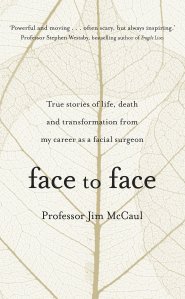
Face to Face by Jim McCaul and All That Remains by Sue Black
 Since starting this blog, I have read various memoirs by medical professionals – a genre which provides thought-provoking insight into the practical and emotional side of modern medicine. From Atul Gawande to Suzanne O’Sullivan to Kathryn Mannix, each has offered new insight into their work and area of expertise, often through the stories of individual patients. I have recently read two more books which broaden the scope of the genre beyond case studies and explore other aspects of the author’s personal lives, careers and their specialties.
In his memoir ‘Face to Face’, Professor Jim McCaul, a consultant surgeon in maxillofacial surgery at Queen Elizabeth University Hospital in Glasgow, recounts cases in which he has restored patients’ appearances following accidents, violence and the removal of tumours from the head and neck (which take up around 80% of his work). Continue reading
Filed under Books
Transcription by Kate Atkinson
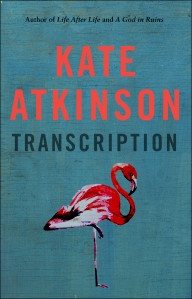 ’Transcription’ is the latest stand-alone novel by Kate Atkinson in which eighteen-year-old Juliet Armstrong is recruited straight out of school by MI5 in 1940 not long after her mother has died. Initially given secretarial tasks as well as the roles usually left to women such as making the tea, she soon begins transcription work monitoring the conversations held in a flat in Pimlico between Fascist sympathisers and an undercover British agent named Godfrey Toby who poses as a member of the Gestapo. A decade later, she is working as a radio producer of children’s programmes at the BBC believing that her wartime activities now lie in the past. However, a chance encounter with Godfrey (also known as John Hazeldine), some threatening notes and a sense that she is being followed remind her that the world of espionage is not one easily left behind and there are some who want Juliet to know that her actions have had far-reaching consequences. Continue reading
Filed under Books



 A Little Blog of Books
You must be logged in to post a comment.