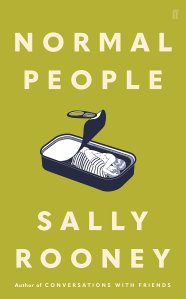
 ‘Normal People’ by Sally Rooney tells the story of teenagers Marianne Sheridan and Connell Waldron who go to school together in the small rural town of Carricklea in the west of Ireland and later move to Dublin to study at Trinity College in the early 2010s. Marianne is a loner from a well-off family while Connell is popular at school and their romance is kept secret from their classmates. However, Marianne finds friends easily among their privileged contemporaries at university whereas Connell feels alienated, and this sudden reversal in their social status complicates their relationship. Continue reading
Tag Archives: Novels
Normal People by Sally Rooney
Filed under Books
Snap by Belinda Bauer
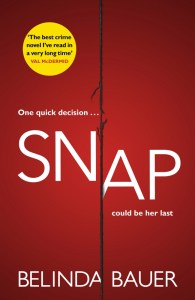 The opening chapter of ‘Snap’ by Belinda Bauer presents a chilling premise based on the unsolved murder of Marie Wilks. On a hot day in the summer of 1998, eleven-year-old Jack Bright is left in a broken-down car by the side of a motorway with his two younger sisters, Joy and Merry, while their pregnant mother, Eileen, goes in search of a telephone for help. However, she never returns and her body is eventually found stabbed to death.
Three years later and abandoned by their father who was unable to cope, Jack turns to burgling houses to provide for his sisters and escape being noticed by social services. On the other side of town, a young pregnant woman, Catherine While, discovers a knife next to her bed with a note that reads “I could have killed you” but she decides not to tell her husband about the break-in or report it to the police. Elsewhere, DS Reynolds who does everything by the book and DCI Marvel who takes a slightly more unorthodox approach towards detective work are investigating multiple burglaries and the identity of Eileen’s killer who still hasn’t been caught and are in a race against time to solve both mysteries. Continue reading
Filed under Books
The Heart’s Invisible Furies by John Boyne
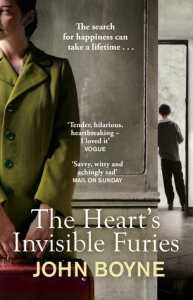 ‘The Heart’s Invisible Furies’ by John Boyne is a 700 page epic novel about the life of a gay man, Cyril Avery, which also encompasses the social history of Ireland in the second half of the 20th century. The story is told in seven-year increments, starting with the circumstances leading up to Cyril’s birth in Dublin in August 1945 to an unmarried teenage mother, Catherine Goggin, right up until the year when Ireland legalised same-sex marriage by public vote in 2015. Cyril is adopted as a baby by novelist Maude Avery and her banker husband Charles who uses every opportunity to remind Cyril that he is “not a real Avery” with the couple depriving him of any real affection. During adolesence and beyond, Cyril has an unrequited crush on his best friend, Julian Woodbead, and this experience shapes the rest of his life as he struggles to be honest with other people and with himself. Continue reading
Filed under Books
The Man Booker Prize 2018 Longlist

The Man Booker Prize longlist for 2018 has been announced today (officially this time – it seems it was accidentally leaked by the Guardian yesterday afternoon). The 13 books are:
Snap by Belinda Bauer
Milkman by Anna Burns
Sabrina by Nick Drnaso
Washington Black by Esi Edugyan
In Our Mad and Furious City by Guy Gunaratne
Everything Under by Daisy Johnson
The Mars Room by Rachel Kushner
The Water Cure by Sophie Mackintosh
Warlight by Michael Ondaatje
The Overstory by Richard Powers
The Long Take by Robin Robertson
Normal People by Sally Rooney
From a Low and Quiet Sea by Donal Ryan Continue reading
Filed under Books
The Man Booker Prize 2018 Longlist: Predictions, Possibilities and Preferences
 The Man Booker Prize longlist will be announced on Tuesday 24th July and the annual guessing game of “posh bingo” commences once again. When considering which books could make the cut, I have been thinking about predictions in terms of likely possibilities and my personal preferences – some I have already read, and some I haven’t. I doubt I will better my predictions last year in which I correctly guessed six out of the 13 “Man Booker dozen” longlisted titles including the eventual winner Lincoln in the Bardo by George Saunders. As ever, I have no knowledge of which books have actually been submitted for consideration so my predictions could just as easily be entirely wrong this time.
I would be surprised if the longlist was as dominated by established authors as it was last year. However, Winter by Ali Smith remains a stand-out preference for me, even if the judges decide to plump for something different following Autumn being shortlisted just last year. Another possibility is The Sparsholt Affair by Alan Hollinghurst about a sex scandal involving students at Oxford University during the Blitz and the consequences this has for their families years down the line. Continue reading
Filed under Books
How to Be Human by Paula Cocozza
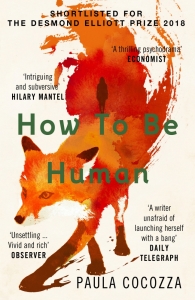
Shortlisted for this year’s Desmond Elliott Prize awarded to debut novels published in the UK, ‘How to Be Human’ by Paula Cocozza tells the story of Mary Green, a woman in her thirties who has recently separated from her partner Mark. Now living alone after buying him out of their home in Hackney in east London, she becomes captivated by an urban fox who regularly visits her garden. Meanwhile, her next door neighbours, Michelle and Eric, regard her new visitor as a pest while Mark makes an unwelcome return into her life. Continue reading
Filed under Books
MaddAddam by Margaret Atwood
 The final part of Margaret Atwood’s MaddAddam trilogy brings together the bioengineered Crakers from Oryx and Crake and the eco-religious cult known as God’s Gardeners from The Year of the Flood. Picking up from where both of these books end after the human race has been almost entirely wiped out by a man-made plague, Toby takes centre stage once again, leading the small community of survivors along with Zeb, a mysterious minor character from ‘The Year of the Flood’. Continue reading
Filed under Books
The Song of Achilles by Madeline Miller
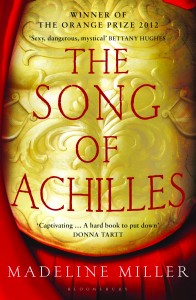 ‘The Song of Achilles’ by Madeline Miller is a modern retelling of ‘The Iliad’ and won the Women’s Prize (then Orange Prize) for Fiction in 2012. Whereas Homer’s epic was told from the perspective of demi-god Achilles as the warrior hero of ancient Greece, it is the exiled prince Patroclus who takes centre stage here, having been a minor character in the original. In Miller’s interpretation of events, Achilles and Patroclus are inseparable childhood friends who later become lovers, and when the time comes for Achilles to fulfil his destiny, Patroclus follows him to war with the Trojans. Continue reading
Filed under Books
Man Booker Prize: The Best of the Shortlists
 The Man Booker Prize is celebrating its 50th anniversary this year with a “best of the best” Golden Man Booker Prize due to be awarded next month. However, while the winning novels have often been met by a mixed response, many of the shortlisted and longlisted titles have been well received and in some cases go on to be better known than those taking the prize that year. So if the past winners don’t inspire you, then here is a selection of “the best of the rest” to consider.
His Bloody Project by Graeme Macrae Burnet – shortlisted in 2016, this is a brilliantly original historical crime novel which blurs the line between fiction and non-fiction with outstanding results. Published by Saraband, a small Scottish independent press, I doubt I would have discovered this if it hadn’t been for the publicity generated by the Man Booker Prize. Continue reading
Filed under Books
Hotel du Lac by Anita Brookner
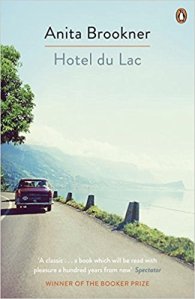 I haven’t read many of the early winners of the Booker Prize but ‘Hotel du Lac’ by Anita Brookner is one I have been meaning to read ahead of the Golden Man Booker Prize celebrations later this year. It tells the story of Edith Hope, a novelist of romantic fiction who is staying at a hotel near Lake Geneva in Switzerland by herself. A keen people-watcher, she has some unusual encounters with various eccentric guests including a rich widow Mrs Pusey and her daughter Jennifer, as well as Monica and her dog Kiki. However, it is Philip Neville, a divorced man also staying at the hotel who makes the most significant impression on the other guests. Continue reading
Filed under Books
4 3 2 1 by Paul Auster
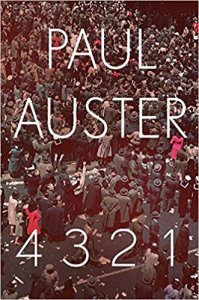 Shortlisted for the Man Booker Prize last year, ‘4 3 2 1’ by Paul Auster consists of four different versions of the life of Archibald Issac Ferguson, born in Newark, New Jersey in 1947 (the same year as Auster). Descended from Russian-Jewish immigrants, Archie is the only child of Rose and Stanley Ferguson and during his early childhood, random events change the path of his life splitting into four different trajectories – in one version his parents divorce, in another they stay together, in another Stanley dies, and so on. The parallel structure means that each of the seven parts is rewound three times before moving on to the next stage in Archie’s life covering his early childhood through to his coming-of-age in the late 1960s. Continue reading
Filed under Books
Sight by Jessie Greengrass
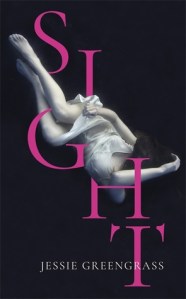 I haven’t yet finished shadowing this year’s Wellcome Book Prize shortlist but I have already come across a novel which has very strong potential to be on next year’s longlist of books which engage in some aspect of health, illness or medicine. I enjoyed reading Jessie Greengrass’s collection of short stories An Account of the Decline of the Great Auk, According to One Who Saw It and her debut novel tells the story of an unnamed narrator who is expecting her second child with her partner, Johannes. During her pregnancy, she reflects on her relationships with her mother who she cared for during her terminal illness and her psychoanalyst grandmother known as “Doctor K”. Continue reading
Filed under Books
Asymmetry by Lisa Halliday
 ‘Asymmetry’ by Lisa Halliday consists of two seemingly unrelated stories which are eventually revealed to have surprising connections. The first part, ‘Folly’, concerns Alice, an editorial assistant in her twenties living in post 9/11 New York City who begins a relationship with a much older man, a Jewish author named Ezra Blazer who has repeatedly been overlooked for a Nobel Prize for Literature. In the second part, ‘Madness’, an Iraqi-American economist, Amar Jaafari, is on his way to Kurdistan to visit his brother but is detained by immigration officials at Heathrow Airport. Continue reading
Filed under Books
The Man Booker International Prize Longlist 2018
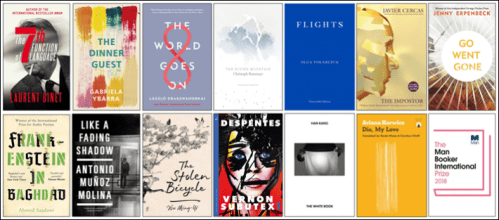
The Man Booker International Prize 2018 longlist was announced yesterday. The 13 books are:
The 7th Function of Language by Laurent Binet, translated by Sam Taylor
The Impostor by Javier Cercas, translated by Frank Wynne
Vernon Subutex 1 by Virginie Despentes, translated by Frank Wynne
Go, Went, Gone by Jenny Erpenbeck, translated by Susan Bernofsky
The White Book by Han Kang, translated by Deborah Smith
Die, My Love by Ariana Harwicz, translated by Sarah Moses and Carolina Orloff
The World Goes On by László Krasznahorkai, translated by John Batki, Ottilie Mulzet and George Szirtes
Like a Fading Shadow by Antonio Muñoz Molina, translated by Camilo A Ramirez
The Flying Mountain by Christoph Ransmayr, translated by Simon Pare
Frankenstein in Baghdad by Ahmed Saadawi, translated by Jonathan Wright
Flights by Olga Tokarczuk, translated by Jennifer Croft
The Stolen Bicycle by Wu Ming-Yi, translated by Darryl Sterk
The Dinner Guest by Gabriela Ybarra, translated by Natasha Wimmer
Filed under Books
The Women’s Prize for Fiction 2018 Longlist Predictions
 The Women’s Prize for Fiction longlist is due to be announced on Thursday 8th March and I have been thinking about which books could make the cut. My predictions last year included the eventual winner The Power by Naomi Alderman which is satisfying but I also hope to be pleasantly surprised by the inclusion of some novels which are new to me.
For many years, there have been 20 titles on the longlist. However, there were supposed to be only 12 last year but the judges decided to increase their selection to 16. This year – who knows? Novels first published in the UK between 1st April 2017 and 31st March 2018 are eligible. Of those I have read, I would be particularly happy to see any of the following on the longlist:
Little Fires Everywhere by Celeste Ng – I really enjoyed this excellent novel set in Shaker Heights, Ohio in the 1990s which addresses adoption, abortion and surrogacy.
Elmet by Fiona Mozley – last year’s Man Booker Prize dark horse blends ancient folklore and dialect with modern settings and political debates. Continue reading
Filed under Books
The Accident on the A35 by Graeme Macrae Burnet
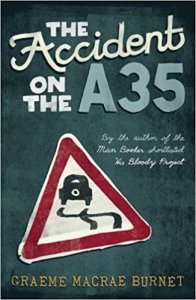 ‘The Accident on the A35’ by Graeme Macrae Burnet sees the return of Inspector Georges Gorski who featured in The Disappearance of Adèle Bedeau. His latest case in the sleepy French town of Saint-Louis in Alsace involves the circumstances surrounding a car accident which fatally injures prominent local solicitor Bertrand Barthelme. Although there is no evidence to suggest a crime has been committed, it is soon discovered that Barthelme had repeatedly lied about his whereabouts to his wife Lucette and teenage son Raymond so Gorski agrees to Lucette’s request to look into the circumstances further. Meanwhile Raymond discovers the address of a house in the rue Saint-Fiacre in Mulhouse on a piece of paper in his father’s desk and sets out to conduct his own investigation.
Filed under Books
The Golden Man Booker Prize
 2018 marks the 50th anniversary of the Man Booker Prize and the organisers have launched a one-off prize to celebrate the best of the winning novels to date.
Five writers and poets will be choosing what they consider to be the best winner from each decade. The judges and their categories are Robert McCrum (1969-1979), Lemn Sissay (1980s), Kamila Shamsie (1990s), Simon Mayo (2000s) and Hollie McNish (2010s). There were joint winners in 1974 and 1992 hence why there are 51 winning novels to date. The “Golden Five” shortlisted books will go to a public vote between 26th May until 25th June and the winner will be announced at the Man Booker 50 festival at the Southbank Centre in London on 8th July. Continue reading
Filed under Books
Larry’s Party by Carol Shields

Winner of the Orange Prize for Fiction in 1998, ‘Larry’s Party’ is the third book I have read by Carol Shields. I read ‘Unless’ a couple of years ago but didn’t love it, didn’t review it and now can’t really remember anything about it. However, I really enjoyed The Stone Diaries back in 2013 and ‘Larry’s Party’ is very similar in many ways – both novels are fictional biographies of “ordinary” people who live quiet yet complex lives. While ‘The Stone Diaries’ spans nearly the whole 20th century, ‘Larry’s Party’ is slightly more focused in scope covering a mere two decades of the life of Laurence “Larry” J. Weller, born in 1950 in Winnipeg to English immigrant parents. Continue reading
Filed under Books
The Mermaid and Mrs Hancock by Imogen Hermes Gowar
 Set in eighteenth century Britain, ‘The Mermaid and Mrs Hancock’ by Imogen Hermes Gowar tells the story of Jonah Hancock, a middle-aged widower and respectable Deptford merchant who discovers that the captain of one of his ships has sold his vessel in exchange for a stuffed “mermaid”. Although initially horrified by this transaction, Mr Hancock is later persuaded to profit from the rare curiosity he has acquired and loans the mermaid to Mrs Chappell for display at her infamous high society parties and Soho brothel. Celebrated courtesan Angelica Neal is tasked with entertaining Mr Hancock which she sees as an irritating distraction at first. However, as the display becomes the talk of London, Angelica decides she wants a mermaid of her own and Mr Hancock does whatever it takes to find another one. Continue reading
Filed under Books
Winter by Ali Smith
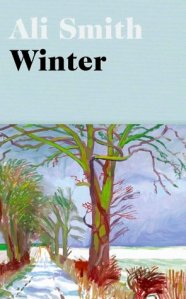 ‘Winter’ is the second volume in the seasons cycle of novels by Ali Smith. It is loosely set at a family gathering in which twenty-something Art (Arthur) visits his mother Sophia Cleves in Cornwall over Christmas. Art has recently been dumped by Charlotte and hires a Croatian-Canadian immigrant, Lux, to pretend to be his girlfriend. Meanwhile, Sophia has a frosty relationship with her subversive sister Iris who has a long history of political activism. Continue reading
Filed under Books



 A Little Blog of Books
You must be logged in to post a comment.