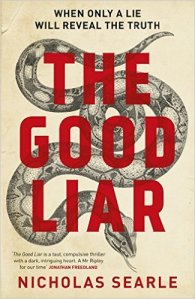
 ‘The Good Liar’ by Nicholas Searle tells the story of Roy Courtnay, a conman aged in his eighties living in the leafy suburbs of England who is attempting to swindle wealthy widow Betty McLeish out of her life savings after meeting her on a dating website. However, although Betty appears to be a very easy target for Roy, she also appears to be suspiciously willing to become his latest victim.
I tend to look out for debut novels at the beginning of the year and ‘The Good Liar’ is one which I featured in my New Books Coming Soon in 2016 blog post last month. Stories about characters who live double lives are always intriguing, particularly when they have been written by an author like Searle who can reveal little about his own career as a senior civil servant dealing with security matters. Continue reading
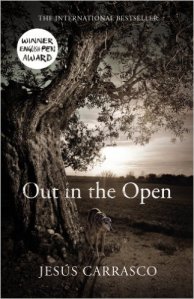 Translated from the Spanish by Margaret Jull Costa, Out in the Open by Jesús Carrasco has been widely compared to ‘The Road’ by Cormac McCarthy. Its unnamed central character is battling to survive in a desolate drought-ridden landscape. Having run away from home for reasons which are revealed towards the end, he strikes up an unlikely friendship with a goatherd. The absence of names for places and characters gives the book a timeless quality and although post-apocalyptic fiction has never been my favourite genre, Margaret Jull Costa’s excellent translation adds colour and depth to a very bleak story.
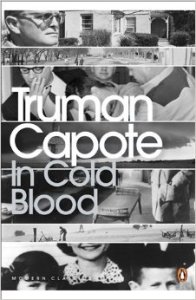 ‘In Cold Blood: A True Account of a Multiple Murder and Its Consequences’ by Truman Capote outlines the investigation into the murders of farmer Herb Clutter, his wife Bonnie and two of their teenage children at their home in Kansas in November 1959. After reading a short news article in the New York Times about the killings, Capote travelled to the small town of Holcomb with his friend, Harper Lee, where he undertook extensive research and interviewed hundreds of people who lived in the area or were involved in the case including the chief investigator, Alvin Dewey, and eventually the murderers themselves.
  The subtitle of Gavin Francis’ travel memoir would be a reasonably concise answer to the question: “What comes to mind when you think of Antarctica?”. While ice and emperor penguins are the more obvious responses to be expected from those who have never been there, it is the silence of such a remote landscape which Francis dwells on in his account of the fourteen months he spent as the base-camp doctor at the British Antarctic Survey’s Halley research station on the Caird Coast. What becomes clear from reading ‘Empire Antarctica’ is that claustrophobia and isolation are also major factors, although that would have made a much less satisfying book title.



 A Little Blog of Books
You must be logged in to post a comment.