 David Nicholls’ fifth novel ‘Sweet Sorrow’ is set during the summer of 1997. Charlie Lewis is waiting for his GCSE results, living with his depressed father and working at a petrol station. In a chance encounter on a bike ride, he becomes a member of the Full Fathom Five amateur theatre company and lands the role of Benvolio in ‘Romeo and Juliet’. Charlie falls for Fran Fisher, the girl playing Juliet, but just like Shakespeare’s famous play, there is plenty of foreshadowing that their happiness will not last long. Continue reading
Tag Archives: Book
Sweet Sorrow by David Nicholls
Filed under Books
The World I Fell Out Of by Melanie Reid and Another Planet by Tracey Thorn
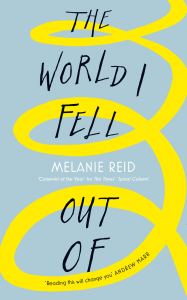 I have read two non-fiction books recently which both draw on regular newspaper columns penned by their authors. In April 2010, at the age of 52, journalist Melanie Reid broke her neck and fractured her back after falling from a horse, spending nearly a year in a high-dependency spinal unit. She is now a tetraplegic, permanently paralysed from the top of her chest downwards and will spend the rest of her life in a wheelchair. She has documented her experience of adult-acquired disability in her ‘Spinal Column’ in the Times for several years now. Her memoir ‘The World I Fell Out Of’ draws on those articles but also provides a fuller account of how her life changed following the accident. Continue reading
Filed under Books
The Booker Prize 2019 Longlist
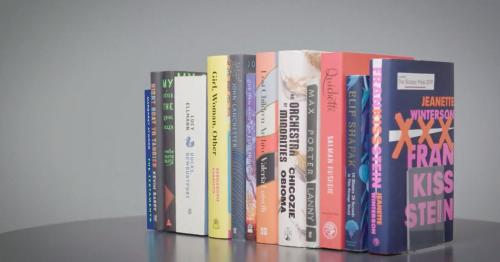 The Booker Prize 2019 longlist was announced on Wednesday. The 13 titles are:
The Testaments by Margaret Atwood
Night Boat to Tangier by Kevin Barry
My Sister, The Serial Killer by Oyinkan Braithwaite
Ducks, Newburyport by Lucy Ellmann
Girl, Woman, Other by Bernardine Evaristo
The Wall by John Lanchester
The Man Who Saw Everything by Deborah Levy
Lost Children Archive by Valeria Luiselli
An Orchestra of Minorities by Chigozie Obioma
Lanny by Max Porter
Quichotte by Salman Rushdie
10 Minutes 38 Seconds In This Strange World by Elif Shafak
Frankissstein by Jeanette Winterson
I posted a list of predictions last Sunday – part personal wish list and part those I thought might be successful based on trends from past longlists. In the end, I got four right: ‘Lost Children Archive’ by Valeria Luiselli which was also on the Women’s Prize for Fiction longlist, ‘Ducks, Newburyport’ by Lucy Ellmann which looks set to be the indie publishing hit of the year, ‘The Wall’ by John Lanchester and ‘The Testaments’ by Margaret Atwood. Overall, there are fewer surprises than usual in a longlist dominated by established names and previous prizewinners. My prediction about historical fiction hasn’t really transpired in the actual longlist which appears to be more focused on contemporary settings and issues, but I will still be looking out for the books I listed last week. Continue reading
Filed under Books
The Booker Prize 2019: Predictions, Possibilities and Preferences
 The Booker Prize longlist (no longer sponsored by the Man Group) for 2019 is due to be announced on Wednesday 24th July which means it’s time for another game of what Julian Barnes once termed “posh bingo”. I’ve come up with a list of predictions in terms of what I think could be some strong possibilities alongside my own personal preferences, based on a few eligible books I have read in recent months as well as ones I haven’t. As ever, I have no idea which novels have actually been submitted for consideration.
Of the eligible books I have read, one of the most striking titles is Throw Me To The Wolves by Patrick McGuinness which is a literary crime novel loosely based on what happened to Christopher Jefferies when he was wrongly accused of murder and follows the 2011 shortlisting for McGuinness’s debut novel The Last Hundred Days. I would also like to see Little by Edward Carey on the longlist which is a fictionalised account of the early life of Madame Tussaud. Continue reading
Filed under Books
Daisy Jones & The Six by Taylor Jenkins Reid
 ‘Daisy Jones & The Six’ by Taylor Jenkins Reid charts the rise to fame of a fictional 1970s rock group based in California and the making of their seminal album ‘Aurora’. Billy Dunne formed The Six with his brother Graham and fellow band members, Eddie, Warren, Karen and Pete. Following the success of a collaboration with Daisy Jones, the solo artist and rising star officially joins the group. However, the dynamic between Billy and Daisy as two competing singer-songwriters soon becomes a fraught one when they embark on creating a hit record together. Continue reading
Filed under Books
The Wife by Meg Wolitzer
 I watched the excellent film adaptation of ‘The Wife’ by Meg Wolitzer recently (currently available to stream on Netflix in the UK) and still had Glenn Close’s performance in mind when I read the book which was first published in 2003, so this week’s blog post is more of a joint review of both. Joan has been married to celebrated novelist Joe Castleman for forty years after meeting in the late 1950s. She was his student in a creative writing class at Smith College and they began an affair which ended his first marriage. In the present day, they are travelling to Scandinavia where Joe is due to receive a literary award – the Nobel Prize for Literature in the film, the fictional Helsinki Prize in the book, which is said to be slightly less important than the Nobel Prize for Literature but prestigious nonetheless. However, during the flight, Joan decides that enough is enough and plans to end their marriage after years of putting up with Joe’s philandering. Continue reading
Filed under Books
Throw Me to the Wolves by Patrick McGuinness
 I enjoyed Patrick McGuinness’s debut The Last Hundred Days which is an evocative portrait of the end of Ceausescu’s rule in Romania and was longlisted for the Man Booker Prize in 2011. His second novel ‘Throw Me to the Wolves’ is inspired by the real events of the Joanna Yeates case in which her landlord, Christopher Jefferies, was arrested on suspicion of her murder in Bristol in December 2010. The retired English teacher was released without charge and the real killer was caught, but extensive press coverage at the time of his arrest had portrayed him as an eccentric loner with false suggestions by ex-pupils that he had behaved inappropriately. In ‘Throw Me to the Wolves’, the setting has been changed to Kent and the character based on Jefferies is Michael Wolphram, accused of the murder of his neighbour Zalie Dyer. Continue reading
Filed under Books
Disobedience by Naomi Alderman
 I enjoyed Naomi Alderman’s Baileys Women’s Prize for Fiction-winning feminist dystopian novel The Power and I have recently read her 2006 debut ‘Disobedience’ which won the Sunday Times Young Writer of the Year Award and Orange Award for New Writers. It tells the story of Ronit Krushka who grew up in a strict Orthodox Jewish community in Hendon in north London and now lives in New York working as a financial analyst having turned her back on her faith and family. She is due to attend a memorial service for her estranged father who was a respected rabbi and it appears that Ronit’s cousin, Dovid, is likely to be his successor. However, when she returns to London, she discovers that Dovid has married Esti, her childhood best friend and former lover. Continue reading
Filed under Books
Mother Ship by Francesca Segal
 I saw Francesca Segal in conversation with Amanda Craig at the Jewish Book Festival in March 2018 and was immediately intrigued when she said she was writing a non-fiction book about the premature birth of her identical twin daughters ten weeks before their due date. Published in the UK this week, ‘Mother Ship’ is presented as a diary of the 56 fraught days the babies (initially known as A-lette and B-lette) spent in the neonatal intensive care unit (NICU) in the weeks leading up to Christmas 2015. Continue reading
Filed under Books
The Capital by Robert Menasse
 I am sure there are many books of various genres currently being written about Britain leaving the European Union right now, but maybe not so many which satirise the complex bureaucracy of the EU itself. However, Robert Menasse’s novel addresses the latter topic, won the German Book Prize in 2017 and has now been translated into English by Jamie Bulloch. Set in Brussels where the headquarters of the main EU institutions are located, the Directorate-General for Culture has been tasked with organising a celebration to mark the 50th anniversary of the European Commission. Martin Susman, the Austrian PA to ambitious Greek Cypriot Fenia Xenopoulou suggests putting Auschwitz survivors at the centre of the jubilee event. Meanwhile, the complexities of European agricultural policy, trade deals and the cost of pork exports to China cause headaches and petty power games galore and Inspector Brunfaut is investigating the death of an unnamed man in the Hotel Atlas. Oh, and a pig is running wild in the streets of Brussels too. Continue reading
Filed under Books
Saltwater by Jessica Andrews
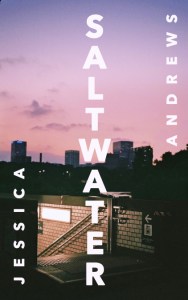 You would be forgiven for thinking that I had pretty much abandoned fiction based on my blog content over the past few months, but I have started reading more novels again recently. Some aspects of Jessica Andrews’ debut ‘Saltwater’ reminded me a lot of ‘Sight’ by Jessie Greengrass, particularly in its visceral imagery concerning changing bodies and an emerging sense of self. Based on Andrews’ life so far, it also appears that there is a strong element of autofiction in this coming-of-age story in which Lucy is finding her way in the world from growing up in Sunderland to her student years in London to inheriting a cottage in Donegal from her grandfather after she graduates from university. Continue reading
Filed under Books
Airhead by Emily Maitlis
 Emily Maitlis has been a journalist and broadcaster for over twenty years and is currently the lead presenter of the BBC’s Newsnight programme. Her first book ‘Airhead’ is a collection of her most significant and memorable TV interviews, with an explanation of the planning and thinking behind each one, as well as the build-up and aftermath off camera. Sometimes the interviews are carefully planned and structured in order to tease out the most telling response from the person being grilled. More often than not, though, the most effective and surprising ones are brought about by happy accident such as her encounter with Anthony Scaramucci. Coupled with the constant sense of unpredictability associated with live television (which is more cock-up than conspiracy, according to Maitlis), the subtitle “the imperfect art of making news” is certainly fitting. Continue reading
Filed under Books
The Ten Types of Human by Dexter Dias
 ‘The Ten Types of Human: Who We Are and Who We Can Be’ by Dexter Dias explores the best and worst of human behaviour – how and why people can be utterly selfless and also commit terrible atrocities. Dias is a human rights lawyer and part-time judge who was presented with a case in which a 15-year-old boy died in a young offender institution when three officers restrained him. ‘The Ten Types of Human’ is the result of years of research combining psychology, philosophy and the neuroscience of decision-making in which Dias seeks to explain the factors which led this to happen.
Filed under Books
The Library Book by Susan Orlean
 ‘The Library Book’ by Susan Orlean documents the devastating fire that raged for seven hours at Los Angeles Public Library in April 1986 and destroyed or damaged over one million books. Investigators quickly concluded that the fire was probably an arson attack but the cause has never been solved and the main suspect, Harry Peak, was arrested but never charged. Continue reading
Filed under Books
Can You Tolerate This? by Ashleigh Young
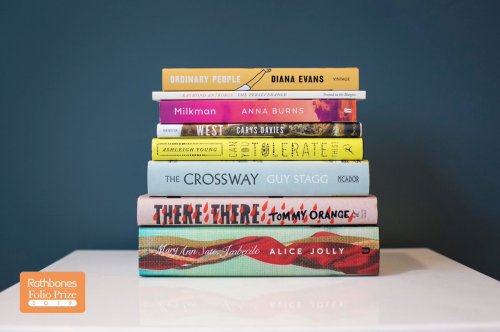
I am championing Ashleigh Young’s collection of essays ‘Can You Tolerate This?’ as part of the Rathbones Folio Prize blog tour today. The eight books on this year’s shortlist include four novels, a novella, two non-fiction books and a collection of poetry whittled down from a list of 80 works published in the UK in 2018 chosen by members of the Folio Academy.
 ‘Can You Tolerate This?’ is Young’s non-fiction debut (she is also a poet) and tackles a diverse range of subjects, mostly leaning towards her own personal experiences of growing up in Te Kuiti in New Zealand as well as a smattering of historical portraits and other topics too. The 20 essays in this collection include her experience of working as the manager at Katherine Mansfield’s birthplace (‘Katherine Would Approve’), Japanese recluses known as hikikomori (‘Sea of Trees’), 19th century French postal worker Ferdinand Cheval (‘Postie’) and her resentment towards a childhood pet (‘Black Dog Book’). However, the main recurring theme in her work is the body, from the short opening essay about a patient with two skeletons (‘Bones’) to musings on her own body hair (‘Wolf Man’) poor eyesight (‘Absolutely Flying’) and yoga and her eating disorder treatment (‘Bikram’s Knee’). Continue reading
Filed under Books
XX by Angela Chadwick
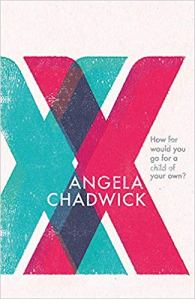 The opening paragraph of ‘XX’ by Angela Chadwick is as good as any to sum up the premise of her debut novel published last year: “After years of controversial research, scientists at Portsmouth University’s Centre for Reproductive Medicine have this morning announced plans to create IVF babies from two women. They’re pushing for a change to the Human Fertilisation and Embryology Act that will make it legal to fertilise an egg with genetic material from a second female.” Lesbian couple Rosie and Jules are quick to take up the opportunity to have a baby of their own through the means of a groundbreaking clinical trial, but a backlash from right-wing movements inevitably creates problems along the way. Continue reading
Filed under Books
Heart: A History by Sandeep Jauhar
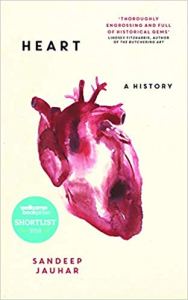 I am taking part in the Wellcome Book Prize blog tour today with a review of ‘Heart: A History’ by Sandeep Jauhar which is the final book I will be shadowing from this year’s shortlist. Jauhar is a cardiologist and director of the Heart Failure Program at Long Island Jewish Medical Center and his third book combines memoir, case studies and the history of cardiology. In the opening pages, he recounts his family history (both of his grandfathers died as a result of sudden cardiac events) and how his own CT angiogram revealed signs of early coronary artery disease. Jauhar’s obsession with this vital and remarkable organ is therefore a very personal one. Continue reading
Filed under Books
Wellcome Book Prize: Mind on Fire and Murmur
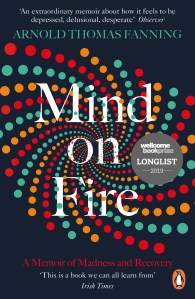 I am approaching the end of shadowing this year’s Wellcome Book Prize, and I have followed two books which explore gender as the central theme (The Trauma Cleaner and Amateur) with two books primarily concerned with mental health. ‘Mind on Fire: A Memoir of Madness and Recovery’ by Arnold Thomas Fanning is a memoir which outlines his experience of bipolar disorder in the late 1990s. Having first suffered from depression at the age of 20 following the death of his mother, he had a breakdown in his late twenties while living in Dublin after quitting his job to concentrate on writing in 1997. He was hospitalised several times and also spent time homeless in London amid periods of mania. The narrative has been pieced together from his own fragmented memories, medical records and interviews with those who were involved at the time. The opening section is a frank stream of consciousness told in the second person while the rest of the narrative is told primarily in the present tense. Continue reading
Filed under Books
Why We Get the Wrong Politicians by Isabel Hardman
 With Parliament still in the grip of deadlock over Brexit, a book with the title ‘Why We Get the Wrong Politicians’ might sound particularly timely. However, even Isabel Hardman admits that the provocative title is slightly misleading. Rather than a populist takedown of lazy and self-serving MPs, her examination of the political class is more sympathetic, as she shows that it tends to be the structural flaws in the system which have caused so much political dysfunction in recent years. Continue reading
Filed under Books
Becoming by Michelle Obama
 ‘Becoming’ by Michelle Obama is already one of the bestselling memoirs of all time selling nearly 10 million copies just four months after it was first published towards the end of 2018. Rebecca, Laura and I optimistically attempted to get tickets for the former First Lady’s sell-out talk with Chimamanda Ngozi Adichie at the Southbank Centre in December along with a mere 44,000 other people. We were, of course, unsuccessful, but I eventually got hold of a library copy of the much talked-about memoir which is split into three parts. “Becoming Me” covers her childhood growing up in the South Side of Chicago, college years at Princeton and Harvard and early legal career. “Becoming Us” begins with her meeting Barack Obama in the late 1980s through to the 2008 presidential election and “Becoming More” which covers the two terms spent at the White House. Continue reading
Filed under Books



 A Little Blog of Books
You must be logged in to post a comment.