 I first read The Handmaid’s Tale by Margaret Atwood about 10 years ago and recently reread it followed by the long-awaited sequel The Testaments. Atwood’s dystopian classic first published in 1985 depicts the Republic of Gilead, a totalitarian and patriarchal state created after the downfall of the United States some time in the 21st century. It is narrated by Offred, a handmaid who is forced to produce children for Commander Waterford and his wife Serena Joy.
As a reread, ‘The Handmaid’s Tale’ was fresher in my mind than it would have been thanks to the recent television series which is a very faithful adaptation of the novel. I particularly admire Atwood’s skill at detailed world-building in relatively spare prose. Even though there isn’t a huge amount of description of what Offred’s surroundings look like or even much explanation about the creation of Gilead initially, Atwood paints a vivid and shocking portrait of this dystopian world, gradually building towards a dramatic conclusion. Continue reading
 The final part of Margaret Atwood’s MaddAddam trilogy brings together the bioengineered Crakers from
 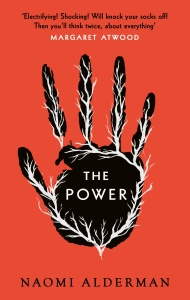 One of the books which kept cropping up frequently in lots of end-of-year book lists last month was ‘The Power’ by Naomi Alderman and so it got bumped up my TBR list as one of my not-very-festive Christmas holiday reads. The main concept of Alderman’s fourth novel explores what would or could happen in a world where women become more powerful than men in every sense. Due to a mutation caused by a nerve agent used during the Second World War, teenage girls develop the ability to release electrical jolts through their fingertips which can be either harmless or strong enough to kill people. The “power” eventually spreads and although it is initially used by women as a deterrent against violent and abusive men who have oppressed them, it has far-reaching implications beyond that.
  I really enjoyed
 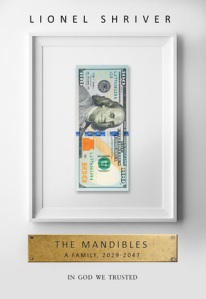 Set in near-future America, ‘The Mandibles: A Family, 2029-2047’ by Lionel Shriver follows four generations of an American family who had been waiting to inherit the fortune of 97-year-old patriarch Douglas Mandible. However, a total fiscal meltdown in the form of a cyber attack has wiped out the economy along with the Mandible’s wealth and all communications including the Internet. After the “Great Renunciation” when the President of the United States defaults on the country’s massive debt obligations, the Mandibles are all forced to live together under one roof in order to survive.
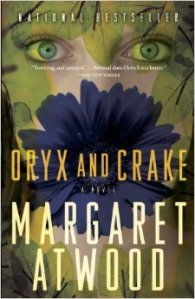 As I read and enjoyed ‘The Handmaid’s Tale’, ‘The Blind Assassin’ and ‘Cat’s Eye’ before I started writing this blog, I thought it was high time I read more of Margaret Atwood’s work. ‘Oryx and Crake’ is the first book in Atwood’s critically acclaimed dystopian MaddAddam trilogy of novels and tells the story of Snowman – also known as Jimmy – who is believed to be the only human survivor left in a post-apocalyptic world along with genetically modified creatures called Crakers. As Snowman makes a journey back to the place where the destruction occurred which wiped out the human population, we learn through flashbacks how the world came to be almost destroyed and what happened to his friend Crake and the mysterious Oryx.


 ‘Blindness’ by José Saramago is a fable about an unexplained mass epidemic of blindness which has unsurprisingly chaotic consequences. The story begins with a man suddenly going blind as he is waiting in his car at some traffic lights. Several other characters who come into contact with him also lose their sight. The blind are quarantined in a mental asylum and left to fend for themselves but criminals soon gain control as society rapidly breaks down completely. Only the doctor’s wife is still able to see for unknown reasons but she doesn’t reveal this fact. Can she still help the others?
  I tried. I really did. But I just couldn’t finish ‘Cloud Atlas’ by David Mitchell. The whole concept/plot was just too damn weird.



 A Little Blog of Books
You must be logged in to post a comment.