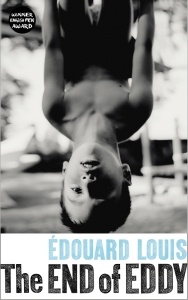
 ‘The End of Eddy’ by Édouard Louis is a semi-autobiographical novel set in a deprived rural community in Picardy in northern France. Translated by Michael Lucey, it is a coming of age tale about Eddy Bellegueule (the author’s real name) and his life at home and at school in the late 1990s and 2000s. Eddy is gay and struggles to conform to what is widely perceived to be an acceptable type of masculinity in the small village where he is expected to go to work in the factory as soon as he leaves school. His mannerisms are routinely mocked by his peers and his family, particularly his father who even chose Eddy’s name because it sounds American and more “tough guy”. ‘The End of Eddy’ garnered lots of attention in France because Louis published his debut novel in 2014 when he was just 21 years old. However, aside from Louis’s young age and the unflinching descriptions of Eddy exploring his sexuality, ‘The End of Eddy’ also deserves acclaim more generally for articulating the reality of social exclusion in modern-day France so convincingly. Many thanks to Harvill Secker for sending me a review copy via NetGalley. Continue reading
Tag Archives: Fiction
3 French Novellas I Have Read Recently
Filed under Books
The Nix by Nathan Hill
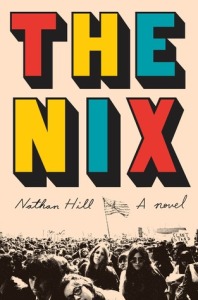 ‘The Nix’ by Nathan Hill tells the story of Samuel Andresen-Anderson, a thirty-something college professor with writer’s block whose estranged mother Faye is arrested for throwing rocks at a conservative Presidential candidate and subsequently portrayed in the media as a radical hippie. Samuel is on the verge of being sued by his publisher for failing to produce the novel he received a huge advance for several years earlier and in order to avoid bankruptcy, he must write a biography of his mother who he hasn’t seen for over twenty years. However, his quest for information about Faye reveals that she has a far more complex past than he ever imagined. Continue reading
Filed under Books
Homesick for Another World by Ottessa Moshfegh

Ottessa Moshfegh’s Man Booker Prize-shortlisted Eileen generated a very mixed reaction among readers last year. However, I was one of those who really enjoyed (if that’s the right word) her debut novel and I was intrigued by her new book ‘Homesick for Another World’, a collection of fourteen short stories which will be published this week in the UK. The tales in this collection range from ‘The Beach Boy’ about a middle-aged couple on an unnamed tropical island to ‘Bettering Myself’ from the perspective of an alcoholic maths teacher in a Catholic school to ‘Nothing Ever Happens Here’ in which an aspiring actor in Hollywood falls for his landlady. Continue reading
Filed under Books
Little Deaths by Emma Flint
Set in the mid-1960s, ‘ Little Deaths’ by Emma Flint tells the story of Ruth Malone, a 26-year-old recently divorced single mother whose two young children Cindy and Frankie go missing from their home in Queens, New York. After they are both found dead in separate locations days later, it doesn’t take long for the police to suspect that Ruth had something to do with their disappearance. However, in the absence of any hard evidence, they draw their conclusions purely from what they consider to be her stylish appearance and unconventional behaviour following the murders. Meanwhile, local journalist Pete Wonicke becomes determined to prove Ruth’s innocence. Continue reading
Filed under Books
The Power by Naomi Alderman
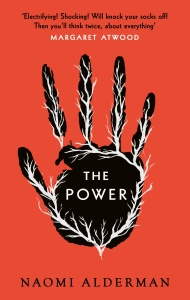 One of the books which kept cropping up frequently in lots of end-of-year book lists last month was ‘The Power’ by Naomi Alderman and so it got bumped up my TBR list as one of my not-very-festive Christmas holiday reads. The main concept of Alderman’s fourth novel explores what would or could happen in a world where women become more powerful than men in every sense. Due to a mutation caused by a nerve agent used during the Second World War, teenage girls develop the ability to release electrical jolts through their fingertips which can be either harmless or strong enough to kill people. The “power” eventually spreads and although it is initially used by women as a deterrent against violent and abusive men who have oppressed them, it has far-reaching implications beyond that. Continue reading
Filed under Books
New Books Coming Soon in 2017
A new year means new books are coming! Here is a selection of books I will be looking out for which are due to be published in the United Kingdom in 2017:
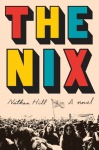 The early months of the year tend to be when lots of debut novels are plugged heavily by publishers. The Nix by Nathan Hill has been a big success in the United States drawing comparisons with everyone from Jeffrey Eugenides to David Foster Wallace and is out this month in the UK. See What I Have Done by Sarah Schmidt is another high-profile debut due in May billed as a historical murder mystery while Lincoln in the Bardo by George Saunders is the long-awaited first novel from the prolific short story writer and is a fictional re-imagining of events following the death of Abraham Lincoln’s son Willie. Continue reading
Filed under Books
Behind the Scenes at the Museum by Kate Atkinson
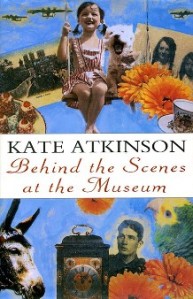 ‘Behind the Scenes at the Museum’ is Kate Atkinson’s debut novel first published in 1995 and narrated by Ruby Lennox born in 1952 to a middle-class family who live above a pet shop in York. The plot alternates between chapters recounting significant events in Ruby’s childhood during the 1950s and 1960s and extended “footnotes” about the earlier generations of her family told in non-chronological order. Most significantly, the story of what happened to Ruby’s great-grandmother Alice has implications for the whole family for many years to come. Continue reading
Filed under Books
My Books of the Year 2016
I have read some excellent books in 2016 both new and not-quite-so-new. Here is a selection of my favourite reads of 2016:
Favourite fiction
 My reading has been dominated by female authors more than ever this year. This isn’t something I deliberately set out to achieve but it is fantastic to see so many brilliant books written by women getting widespread attention. I highly recommend The Tidal Zone by Sarah Moss and The Wonder by Emma Donoghue which could be possible contenders for next year’s Wellcome Book Prize awarded to a fiction or non-fiction book about health or medicine.
 I really enjoyed The Essex Serpent by Sarah Perry which is one of the most original historical novels I have read in a long time while other recent favourites with a more modern setting include Swing Time by Zadie Smith, the Brexit-themed Autumn by Ali Smith and This Must Be The Place by Maggie O’Farrell. Continue reading
Filed under Books
His Bloody Project by Graeme Macrae Burnet
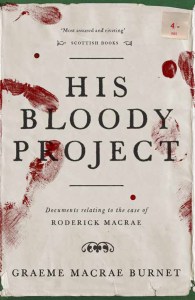 Shortlisted for this year’s Man Booker Prize, ‘His Bloody Project’ by Graeme Macrae Burnet tells the story of seventeen-year-old Roderick Macrae, accused of committing three brutal murders in a remote village in the Scottish Highlands in 1869. Presented as a series of documents “discovered” by the author whilst researching his family history, the first half of the book consists of Roddy’s written statement in which he confesses to the crimes and gives his version of events leading up to the murders followed by an account of the trial and verdict. The identity of one of the victims is revealed at the beginning to be local constable Lachlan Mackenzie while the other two remain a mystery until the event itself occurs. Continue reading
Filed under Books
The Bird Tribunal by Agnes Ravatn
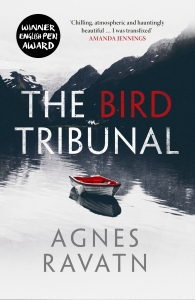 Translated from the Norwegian by Rosie Hedger, ‘The Bird Tribunal’ by Agnes Ravatn tells the story of Allis Hagtorn, a former TV presenter who goes into self-imposed exile from her home, job and partner after she is involved in a scandal at work. She finds a new job as a housekeeper and gardener for a man called Sigurd Bagge in the middle of nowhere despite having no real experience in that type of role. Before arriving at his isolated house by the Norwegian fjords, she expects to be caring for an elderly man but discovers on arrival that Sigurd is in his forties and is not much older than her, simply requiring some extra help in the house and garden while his wife is away. Sigurd rarely talks to Allis and has violent mood swings but she finds herself being increasingly drawn to him. Continue reading
Filed under Books
The Tokyo Zodiac Murders by Soji Shimada
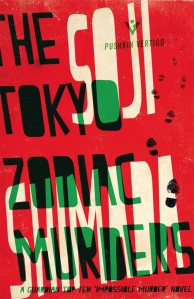
Translated from the Japanese by Ross and Shika Mackenzie, ‘The Tokyo Zodiac Murders’ by Soji Shimada opens with the last will and testament of Heikichi Umezawa written in 1936. Heikichi is an artist obsessed with alchemy and astrology who outlines his plans to create the supreme woman Azoth by killing and dismembering his female relatives. However, the murders he had planned in his confession are carried out by someone else several weeks after Heikichi himself is murdered in a room locked from the inside. Having baffled investigators for decades, the case remains unsolved over forty years later in 1979 until Kiyoshi Mitari and his sidekick and narrator Kazumi try to crack one of the most intriguing locked room cold cases of all time. Continue reading
Filed under Books
The Sunday Times/PFD Young Writer of the Year Award 2016
Sponsored by the Sunday Times and literary agency Peters Fraser & Dunlop, the Young Writer of the Year Award recognises the best literary work of fiction, non-fiction or poetry by a British or Irish writer aged between 18 and 35, with £5,000 awarded to the winner for outstanding literary merit. Following a hiatus since 2009, it was relaunched last year and won by Sarah Howe for her poetry collection ‘Loop of Jade’.
Filed under Books
Nutshell by Ian McEwan
 Although Ian McEwan has tackled a vast range of subject matters in his literary fiction, many of his books fall into specific categories or share distinct themes. There are the early macabre works like ‘The Cement Garden’, the espionage stories such as ‘The Innocent’ or Sweet Tooth, the state-of-the-nation novels like ‘Saturday’ or The Children Act and then there are the books like ‘Nutshell’ which somehow fall into all of these categories. Nutshell’ is a unique interpretation of William Shakespeare’s ‘Hamlet’ from the point of view of an unnamed foetus who overhears a murder plot hatched by his mother Trudy and her lover Claude to kill John, who is Trudy’s husband and Claude’s brother, and cash in on the value of their marital home.
Continue reading
Filed under Books
The Year of the Flood by Margaret Atwood
 I really enjoyed Oryx and Crake by Margaret Atwood a couple of years ago and have finally got round to reading the second book in her acclaimed MaddAddam trilogy ‘The Year of the Flood’. Set in the same universe as ‘Oryx and Crake’, ‘The Year of the Flood’ follows a lower class eco-religious cult known as the God’s Gardeners and their alternative perspective of the same apocalypse. Only two women from the community, Toby and Ren, survive the catastrophe which was predicted years earlier by the Gardeners who coined it the Waterless Flood. Continue reading
Filed under Books
Autumn by Ali Smith
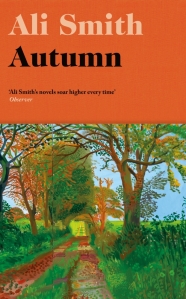 ‘Autumn’ is the first of four books in a planned series of novels by Ali Smith named after the seasons and which focus on how we experience time. Set during the fallout of the Brexit referendum result in 2016, it follows the friendship between Elisabeth Demand, a thirty-two-year-old history of art lecturer and her eccentric 101-year-old former next-door neighbour Daniel Gluck who is spending his dying days in an assisted care facility. Continue reading
Filed under Books
Swing Time by Zadie Smith
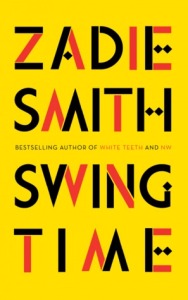 ‘Swing Time’ by Zadie Smith tells the story of two mixed-race girls, an unnamed narrator and her friendship with Tracey who grow up together on neighbouring council estates in north-west London in the 1980s. From Fred Astaire to Michael Jackson, music and dance dominate their lives but it is only Tracey who has the real talent to pursue a career as a dancer. The narrator goes to university and works as a personal assistant for mononymous international pop star Aimee who decides to set up a school for girls in west Africa. The story alternates between the past and present and even though the girls spend a considerable time apart in later years, Tracey’s influence can always be felt. Continue reading
Filed under Books
The Wonder by Emma Donoghue
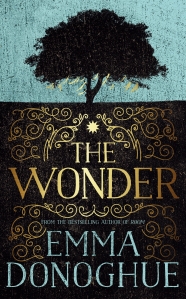 ‘The Wonder’ by Emma Donoghue tells the story of Lib Wright, a widowed English nurse who trained under Florence Nightingale during the Crimean war. She is sent to a rural village in Ireland to independently observe Anna O’Donnell, an eleven-year-old girl whose parents claim has not eaten any solid food for four months, subsisting purely on “manna from heaven” and a few teaspoons of water a day. While the community accepts this claim without questioning it and visitors travel from afar to witness the miracle, Lib is immediately sceptical and expects the medical surveillance to be over in a couple of days once the fraud has been exposed. She alternates her shifts with a local nun Sister Michael and considers every possible way food could have been secretly smuggled to Anna. However, as more time passes, Lib starts to doubt her own beliefs and realises that there is more to Anna’s case than meets the eye.
Continue reading
Filed under Books
The Winterlings by Cristina Sánchez-Andrade
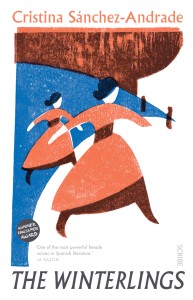 ‘The Winterlings’ by Cristina Sánchez-Andrade was one of my Women in Translation Month reads in August and my rather belated review is finally here. Translated from the Spanish by Samuel Rutter, it tells the story of two sisters, Saladina and Dolores, from the small rural village of Tierra de Chá in Galicia in north-west Spain. After living in England for several years during and after the Spanish Civil War, the Winterlings, as they are known, eventually return to their grandfather’s cottage as adults in the 1950s. However, the sisters have secrets about why they have decided to come back while the villagers are equally evasive about what happened to their grandfather during the war. Continue reading
Filed under Books
Life: A User’s Manual by Georges Perec
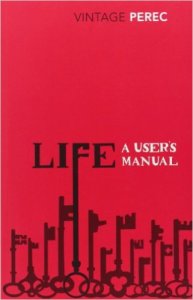 I first came across Georges Perec’s work at university through his first novel ‘Things: A Story of the Sixties’ which was by far the most interesting book I had to read for one of my French literature modules focusing on consumerism. I’ve had ‘Life: A User’s Manual’ on my TBR list ever since which is probably Perec’s best known novel published in 1978 and translated from the French by David Bellos in 1987. Continue reading
Filed under Books
We Are All Completely Beside Ourselves by Karen Joy Fowler
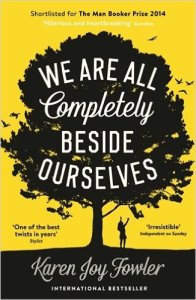 It would have been interesting to read ‘We Are All Completely Beside Ourselves’ without knowing the twist which is revealed on page 77. However, as Karen Joy Fowler’s sixth novel has been one of the more commercially successful and widely discussed Man Booker Prize shortlisted books in recent years, I assume that the majority of potential readers will already know the basic premise of the story. Although I don’t think knowing about the big revelation beforehand lessened my enjoyment of the novel, if you still don’t want to read any further spoilers, then look away now. Continue reading
Filed under Books



 A Little Blog of Books
You must be logged in to post a comment.