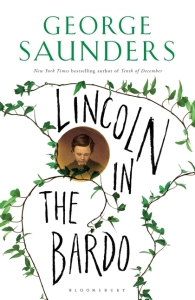
 Told through a chorus of over 160 different voices, ‘Lincoln in the Bardo’ by George Saunders follows the aftermath of the death of Abraham Lincoln’s eleven-year-old son Willie in 1862 from typhoid fever during the American Civil War. Willie finds himself trapped between death and rebirth with other spirits in the cemetery who believe he should proceed to the next stage of the afterlife. However, Willie is resistant as he wants to spend more time with his distraught father who regularly visits the crypt to mourn his loss. Continue reading
Man Booker International Reviews: Part 4 (and the official shortlist)
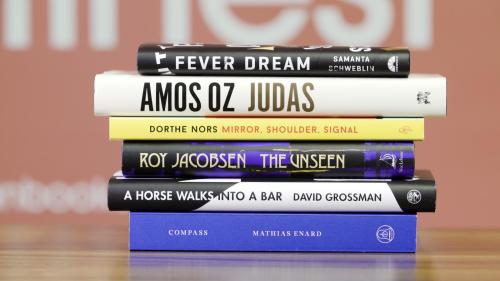
The official Man Booker International Prize shortlist of six books was announced on Thursday:
- Compass by Mathias Enard (translated from the French by Charlotte Mandell)
- A Horse Walks Into a Bar by David Grossman (translated from the Hebrew by Jessica Cohen)
- The Unseen by Roy Jacobsen (translated from the Norwegian by Don Bartlett and Don Shaw)
- Mirror, Shoulder, Signal by Dorthe Nors (translated from the Danish by Misha Hoekstra)
- Judas by Amos Oz (translated from the Hebrew by Nicholas de Lange)
- Fever Dream by Samanta Schweblin (translated from the Spanish by Megan McDowell)
I think this is an interesting selection with some very strong contrasts in genre and style. The shadow panel shortlist will be revealed at a later date as we have decided to allow ourselves a bit more time to finish reading the longlist and deliberate our views. You will have to wait until 9am UK time on Thursday 4th May to find out how many of our collective choices match those of the official judges… Continue reading
Filed under Books
How to Survive a Plague by David France
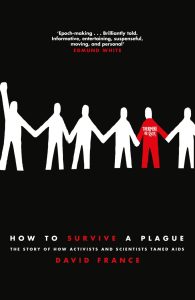 I am very pleased to be taking part in the official Wellcome Book Prize blog tour this week to champion ‘How to Survive a Plague’ by David France which is one of six titles shortlisted for this year’s prize awarded to a book on the subject of healthcare or medicine. It follows France’s 2012 Oscar-nominated documentary film of the same name and is a remarkable account of the activists and scientists who campaigned for awareness and funding towards fighting the AIDS epidemic in the United States.
Continue reading
Filed under Books
Man Booker International Prize Reviews: Part 3
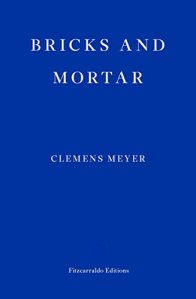 Bricks and Mortar by Clemens Meyer is the biggest of the big tomes on this year’s longlist and I have been reading it in between other books on the longlist over the last three weeks. For that reason, I’m not sure if I felt the full force of its power but as the book is so fragmented anyway, I don’t think I felt any more disorientated each time I picked it up again than I would have done if I had read it straight through without distractions. Translated from the German by Katy Derbyshire, it follows a variety of characters involved in the sex trade in an unnamed East German city from the end of the Cold War to the present day exploring the consequences of legalised prostitution, corruption, capitalism, and much much more. Each chapter explores a different character associated in some way with the industry and the chorus of unique voices effectively becomes a collection of interconnected short stories. At the centre of the story is Arnold Kraushaar and his rise “from football hooligan to large-scale landlord and service-provider for prostitutes”. Continue reading
Filed under Books
Film Review: The Sense of an Ending
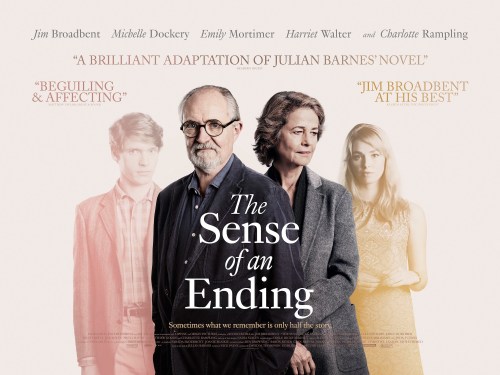
A couple of weeks ago, I attended a preview screening of the film adaptation of ‘The Sense of an Ending’, based on Julian Barnes’s bestselling novella first published in 2011. The story follows Tony Webster, a divorced, middle-class, semi-retired man living in London where he runs a vintage camera shop. His memories of events in the past concerning his relationship with Veronica Ford at Bristol University and friendship with Adrian Finn in the 1960s and the tragic consequences which followed are somewhat different from how others remember them. When Tony receives a letter from a solicitor regarding a legacy left by Veronica’s late mother, he is forced to re-examine what actually happened so many years ago. Continue reading
Filed under Books
Man Booker International Prize Reviews: Part 2
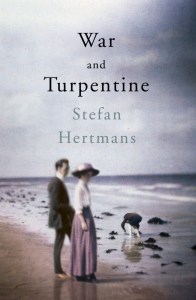 My Man Booker International Prize shadowing duties continue with two more reviews this week. First up is War and Turpentine by Stefan Hertmans which has been translated from the Dutch by David McKay. Hertmans inherited his grandfather’s diaries after his death in 1981 and eventually used these personal memoirs to create a compelling narrative of his life as an ironworker, soldier and amateur painter. Born in 1891, the first part of the book focuses on Urbain Martien’s childhood in Ghent in a working class family with his father Franciscus and mother Céline. Hertmans also inserts himself into this part of the story as he unravels his family history in the present day. The second part is a more conventional narrative of Urbain’s experiences in the trenches following the German invasion of Belgium. The final part recounts the post-war years during which Martien sought solace in painting and a secret at the heart of his marriage to Gabrielle is revealed.
Continue reading
Filed under Books
Man Booker International Prize Reviews: Part 1
 The shadow panel members have been busy reading the titles longlisted for the Man Booker International Prize. Here are my thoughts about the first four books I have read since the announcement last month:
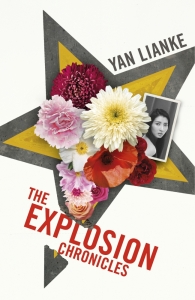
Yan Lianke’s novel The Four Books was shortlisted for the Man Booker International Prize last year and was one of the most interesting new discoveries I made last year. Translated from the Chinese by Carlos Rojas, The Explosion Chronicles follows three families – the Kongs, the Zhus and the Chens – who compete to turn their small village into a super metropolis. Lianke’s latest novel to be translated into English is another absurdist satire which criticises corruption, capitalist excess and China’s rapid economic growth with impressive detail and the way in which the story is presented as a history of the town as a sort of miniature account of what has happened to the country in general is done very effectively. Continue reading
Filed under Books
Spaceman of Bohemia by Jaroslav Kalfar
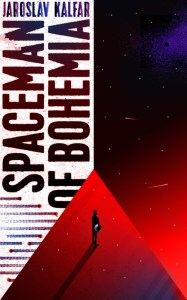 Out of all of the debut novels which have been published recently, ‘Spaceman of Bohemia’ by Jaroslav Kalfar has one of the most intriguing and original premises. Set in 2018, it tells the story of Jakub Procházka, a Czech astrophysicist turned astronaut on a solo mission to investigate a dust cloud between Earth and Venus and collect samples for analysis. However, his marriage to Lenka is under further strain as she is left behind on Earth and Jakub has plenty of time on his own to reflect on his family’s past. The appearance of a giant Nutella-loving alien spider called Hanuš who may or may not be a figment of Jakub’s imagination only complicates things further.
Filed under Books
Man Booker International Prize: Shadow Panel Response
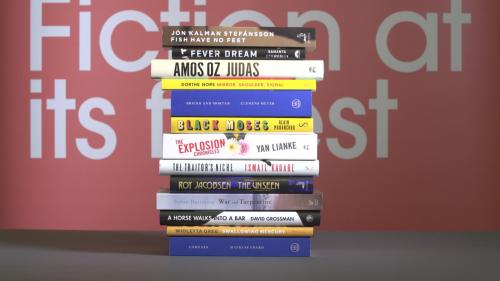
Here is our shadow panel response to the Man Booker International Prize longlist announced earlier this week (thanks to Tony for collating our initial thoughts):
The Shadow Panel for the 2017 Man Booker International Prize would like to extend its congratulations and thanks to the official judges for their hard work in whittling down the 126 entries to the thirteen titles making up the longlist. In some ways, it is a somewhat unexpected selection, with several surprising inclusions, albeit more in terms of the lack of fanfare the works have had than of their quality. However, it is another example of the depth of quality in fiction in translation, and it is heartening to see that there is such a wealth of wonderful books making it into our language which even devoted followers of world literature haven’t yet sampled. Of course, at this point we must also thank the fourteen translators who have made this all possible, and we will endeavour to highlight their work over the course of our journey.
Continue reading
Filed under Books
The Man Booker International Prize Longlist 2017
The longlist for the Man Booker International Prize 2017 was announced today. The 13 books are:
- Compass by Mathias Énard (translated from the French by Charlotte Mandell)
- Swallowing Mercury by Wioletta Greg (translated from the Polish by Eliza Marciniak)
- A Horse Walks Into a Bar by David Grossman (translated from the Hebrew by Jessica Cohen)
- War and Turpentine by Stefan Hertmans (translated from the Dutch by David McKay)
- The Unseen by Roy Jacobsen (translated from the Norwegian by Don Bartlett and Don Shaw)
- The Traitor’s Niche by Ismail Kadare (translated from the Albanian by John Hodgson)
- Fish Have No Feet by Jón Kalman Stefánsson (translated from the Icelandic by Philip Roughton)
- The Explosion Chronicles by Yan Lianke (translated from the Chinese by Carlos Rojas)
- Black Moses by Alain Mabanckou (translated from the French by Helen Stevenson)
- Bricks and Mortar by Clemens Meyer (translated from the German by Katy Derbyshire)
- Mirror, Shoulder, Signal by Dorthe Nors (translated from the Danish by Misha Hoekstra)
- Judas by Amos Oz (translated from the Hebrew by Nicholas de Lange)
- Fever Dream by Samanta Schweblin (translated from the Spanish by Megan McDowell)
Filed under Books
The Man Booker International Prize 2017: Longlist Predictions

The longlist for the Man Booker International Prize is due to be announced on Wednesday 15th March. I am on the shadow panel again this year and have been thinking about which books could make the cut.
The pool of fiction in translation published in the UK is smaller than the huge number of books which are eligible for awards like the Man Booker Prize and Baileys Women’s Prize for Fiction. However, thanks to consistent championing by booksellers, bloggers and publishers helping to steadily raise the profile of translated fiction, it doesn’t actually make the predictions easier (which is ultimately a good thing, of course). I also have no knowledge of which books have actually been submitted for consideration so my choices are purely speculative. Continue reading
Filed under Books
The Baileys Women’s Prize for Fiction Longlist 2017

The Baileys Women’s Prize for Fiction longlist for 2017 was announced today. The 16 books are:
Stay With Me by Ayòbámi Adébáyò The Power by Naomi Alderman Hag-Seed by Margaret Atwood Little Deaths by Emma Flint The Mare by Mary Gaitskill The Dark Circle by Linda Grant The Lesser Bohemians by Eimear McBride Midwinter by Fiona Melrose The Sport of Kings by CE Morgan The Woman Next Door by Yewande Omotoso The Lonely Hearts Hotel by Heather O’Neill The Essex Serpent by Sarah Perry Barkskins by Annie Proulx First Love by Gwendoline Riley Do Not Say We Have Nothing by Madeleine Thien The Gustav Sonata by Rose Tremain Continue readingFiled under Books
Fever Dream by Samanta Schweblin
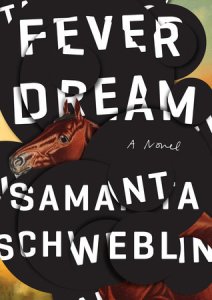 Translated from the Spanish by Megan McDowell, ‘Fever Dream’ by Samanta Schweblin tells the story of Amanda, a woman who is critically ill in a rural Argentinian hospital, where David is trying to get her to remember the events which led her there. She recalls encounters with her daughter Nina and David’s mother Carla who once told her how David’s soul was split in two in order to save him after he was poisoned. However, David is not quite the same afterwards, and neither are Amanda and Nina. Continue reading
Filed under Books
The Baileys Women’s Prize for Fiction 2017: Longlist Predictions
 Having had some success with my Man Booker Prize predictions last year with three of my choices appearing on the longlist, I have been thinking about possible contenders for the Baileys Women’s Prize for Fiction ahead of the longlist announcement on Wednesday 8th March.
As with my Man Booker Prize predictions list, I have been considering eligible books in terms of preferences and possibilities. There will be just 12 books on the longlist this year, down from 20 in previous years. This makes it much harder to narrow down my choices but my top personal preferences include:
This Must Be the Place by Maggie O’Farrell – O’Farrell’s seventh novel spanning across decades and continents is among her finest in my opinion.
The Essex Serpent by Sarah Perry – a critical and commercial success, Perry’s second novel didn’t make the Man Booker Prize longlist and it will be surprising to many if it misses out on this one too.
The Tidal Zone by Sarah Moss – another book I hoped would be a Man Booker Prize contender last summer, I would really like to see Moss’s fifth novel recognised by the Baileys Prize judges. Continue reading
Filed under Books
The Accusation by Bandi
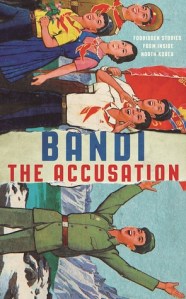 Translated from the Korean by last year’s Man Booker International Prize winner Deborah Smith ‘The Accusation’ by Bandi is a collection of seven short stories by a pseudonymous author who reportedly still lives in North Korea and works as an official writer for the government. Written in the early 1990s at a time when the country was gripped by famine, it is said that Bandi’s stories were eventually smuggled into South Korea by a relative who hid sheets of paper in a copy of ‘The Selected Works of Kim Il-sung’. While there have been many accounts of life in North Korea published by defectors, a work of fiction by an author still living in one of the most secretive countries in the world is exceptionally rare. Continue reading
Filed under Books
Harmless Like You by Rowan Hisayo Buchanan
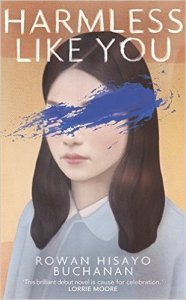 ‘Harmless Like You’ by Rowan Hisayo Buchanan tells the story of Yukiko Oyama, a teenager in New York in 1968 whose parents move back to Japan after emigrating to the United States when she was a child. She decides to stay in New York with her friend Odile to pursue her dream of becoming an artist. Many years later, her son Jay, who has recently become a father himself, travels to Berlin to find his estranged mother and inform Yuki that his father has died and has left the house to her in his will. The journey also leads Jay to discover why Yuki abandoned him suddenly when he was just two years old. Continue reading
Filed under Books
Bel Canto by Ann Patchett
 Winner of the Orange Prize for Fiction in 2002, ‘Bel Canto’ by Ann Patchett is set during a birthday party for Japanese businessman Katsumi Hosokawa held in his honour at the vice-president’s mansion in an unnamed South American country. While entertainment is provided by renowned American opera singer Roxane Coss, the property is suddenly stormed by terrorists who had originally planned to kidnap the president. However, in his absence, they end up holding dozens of guests under house arrest for several months. Continue reading
Filed under Books
American Wife by Curtis Sittenfeld
 I enjoyed reading Sisterland by Curtis Sittenfeld a couple of years ago and as part of my ongoing efforts to read other books by authors I have discovered since starting my blog, I turned to Sittenfeld’s best known novel ‘American Wife’ which was published in 2008. It is a portrait of Alice Lindgren and her path towards becoming First Lady of the United States in 2001, from her youth in Wisconsin, to marriage and motherhood in her thirties through to her life in the White House during her husband’s unpopular presidency. Knowing that the story was inspired by key events in the life of Laura Bush means it is difficult not to picture Alice’s husband Charlie Blackwell as George W. Bush who took office in the same year. Continue reading
Filed under Books
The Wellcome Book Prize Longlist 2017
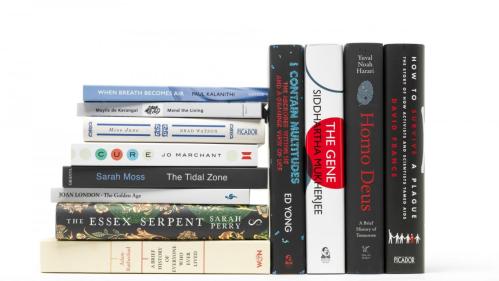
The Wellcome Book Prize is awarded to a fiction or non-fiction book about health or medicine. Since its launch in 2009, there has been a shortlist of six books but this year, there is a longlist of twelve books for the very first time. The nominated books which were announced today are:
- How to Survive a Plague by David France
- Homo Deus by Yuval Noah Harari
- When Breath Becomes Air by Paul Kalanithi
- Mend the Living by Maylis de Kerangal (translated from the French by Jessica Moore)
- The Golden Age by Joan London
- Cure by Jo Marchant
- The Tidal Zone by Sarah Moss
- The Gene by Siddhartha Mukherjee
- The Essex Serpent by Sarah Perry
- A Brief History of Everyone Who Ever Lived by Adam Rutherford
- Miss Jane by Brad Watson
- I Contain Multitudes by Ed Yong
Filed under Books
3 French Novellas I Have Read Recently
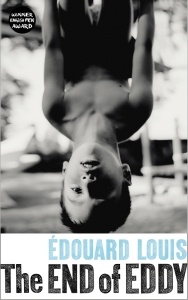 ‘The End of Eddy’ by Édouard Louis is a semi-autobiographical novel set in a deprived rural community in Picardy in northern France. Translated by Michael Lucey, it is a coming of age tale about Eddy Bellegueule (the author’s real name) and his life at home and at school in the late 1990s and 2000s. Eddy is gay and struggles to conform to what is widely perceived to be an acceptable type of masculinity in the small village where he is expected to go to work in the factory as soon as he leaves school. His mannerisms are routinely mocked by his peers and his family, particularly his father who even chose Eddy’s name because it sounds American and more “tough guy”. ‘The End of Eddy’ garnered lots of attention in France because Louis published his debut novel in 2014 when he was just 21 years old. However, aside from Louis’s young age and the unflinching descriptions of Eddy exploring his sexuality, ‘The End of Eddy’ also deserves acclaim more generally for articulating the reality of social exclusion in modern-day France so convincingly. Many thanks to Harvill Secker for sending me a review copy via NetGalley. Continue reading
Filed under Books




 A Little Blog of Books
You must be logged in to post a comment.