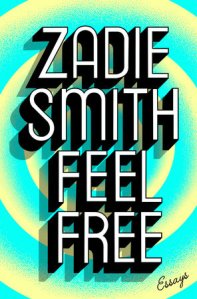
 ‘Feel Free’ is a new collection of over thirty essays, reviews and interviews by Zadie Smith divided into five sections. The first and last of these, ‘In the World’ and ‘Feel Free’, cover current events and some autobiographical “life writing”, while ‘In the Audience’, ‘In the Gallery’ and ‘On the Bookshelf’ concern her musings on film, art and writing respectively.
Covering a vast array of topics, the collection opens with an impassioned defence of libraries (“the only thing left on the high street that doesn’t want either your soul or your wallet”) while a new security fence constructed around her daughter’s primary school is the springboard for a nuanced and insightful piece on Brexit. As to be expected, some of the more in-depth reviews may only be of real interest for those who already know about the subject matter. I am familiar with some of the films and authors discussed here (‘The Social Network’, ‘Get Out’ and Karl Ove Knausgaard are all featured), but it has to be said that the more academic essays about art were less appealing to me and I skimmed most of these. As well as subject matter, the essays were originally written for very different audiences across different publications and while many pieces first appeared in the New York Review of Books and Harper’s magazine, some were delivered as lectures. Continue reading
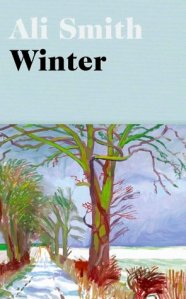 ‘Winter’ is the second volume in the seasons cycle of novels by Ali Smith. It is loosely set at a family gathering in which twenty-something Art (Arthur) visits his mother Sophia Cleves in Cornwall over Christmas. Art has recently been dumped by Charlotte and hires a Croatian-Canadian immigrant, Lux, to pretend to be his girlfriend. Meanwhile, Sophia has a frosty relationship with her subversive sister Iris who has a long history of political activism.
 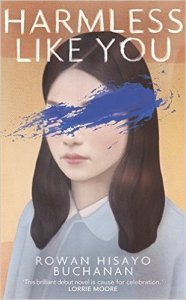 ‘Harmless Like You’ by Rowan Hisayo Buchanan tells the story of Yukiko Oyama, a teenager in New York in 1968 whose parents move back to Japan after emigrating to the United States when she was a child. She decides to stay in New York with her friend Odile to pursue her dream of becoming an artist. Many years later, her son Jay, who has recently become a father himself, travels to Berlin to find his estranged mother and inform Yuki that his father has died and has left the house to her in his will. The journey also leads Jay to discover why Yuki abandoned him suddenly when he was just two years old.
 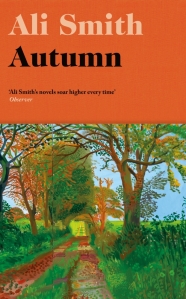 ‘Autumn’ is the first of four books in a planned series of novels by Ali Smith named after the seasons and which focus on how we experience time. Set during the fallout of the Brexit referendum result in 2016, it follows the friendship between Elisabeth Demand, a thirty-two-year-old history of art lecturer and her eccentric 101-year-old former next-door neighbour Daniel Gluck who is spending his dying days in an assisted care facility.
  ‘The Muse’ by Jessie Burton tells the story of a young Trinidadian woman Odelle Bastien who lands a job as a typist at the prestigious Skelton art gallery in London in 1967, five years after she moved to the city. Odelle’s new boyfriend Lawrie has recently inherited a painting rumoured to be the work of Isaac Robles, a talented young Spanish artist who mysteriously disappeared during the Civil War in the 1930s. The painting causes quite a stir at the Skelton and Odelle’s enigmatic boss, Marjorie Quick, appears to have a personal interest in the painting as well as a professional one. Odelle sets out to uncover the true origins of the lost masterpiece whose secrets lie with the wealthy Anglo-Austrian Schloss family who employed Isaac’s sister Teresa as their housekeeper in Malaga at the beginning of the war.
  ‘The Hare with Amber Eyes: A Hidden Inheritance’ is Edmund de Waal’s highly acclaimed memoir tracing his family history through a collection of objects. In the early 1990s, De Waal studied ceramics in Tokyo as part of a two-year scholarship where he met his great-uncle Ignace (Iggie). Following Iggie’s partner’s death, de Waal inherited 264 Japanese miniature wood and ivory carvings known as netsuke often representing animals, people or mythical creatures. Traditionally used as toggles to attach carrying pouches to Japanese robes, netsuke were originally designed to be useful everyday objects rather than purely decorative ones. De Waal became intrigued by the story behind the collection and how it came to be passed down through the generations of his family across the world.
 Last summer, I read ‘





 A Little Blog of Books
You must be logged in to post a comment.