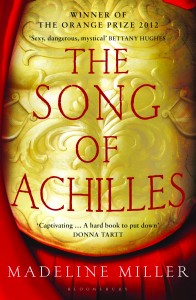
 ‘The Song of Achilles’ by Madeline Miller is a modern retelling of ‘The Iliad’ and won the Women’s Prize (then Orange Prize) for Fiction in 2012. Whereas Homer’s epic was told from the perspective of demi-god Achilles as the warrior hero of ancient Greece, it is the exiled prince Patroclus who takes centre stage here, having been a minor character in the original. In Miller’s interpretation of events, Achilles and Patroclus are inseparable childhood friends who later become lovers, and when the time comes for Achilles to fulfil his destiny, Patroclus follows him to war with the Trojans. Continue reading
Tag Archives: Book
The Song of Achilles by Madeline Miller
Filed under Books
Man Booker Prize: The Best of the Shortlists
 The Man Booker Prize is celebrating its 50th anniversary this year with a “best of the best” Golden Man Booker Prize due to be awarded next month. However, while the winning novels have often been met by a mixed response, many of the shortlisted and longlisted titles have been well received and in some cases go on to be better known than those taking the prize that year. So if the past winners don’t inspire you, then here is a selection of “the best of the rest” to consider.
His Bloody Project by Graeme Macrae Burnet – shortlisted in 2016, this is a brilliantly original historical crime novel which blurs the line between fiction and non-fiction with outstanding results. Published by Saraband, a small Scottish independent press, I doubt I would have discovered this if it hadn’t been for the publicity generated by the Man Booker Prize. Continue reading
Filed under Books
Three Non-Fiction Books About Books
I have been reading more non-fiction than ever recently, moving away from the science and medical themed books I covered for the Wellcome Book Prize shortlist to memoirs about all things literary, specifically writing, libraries and children’s literature. Here are three titles I recommend to bookworms everywhere:
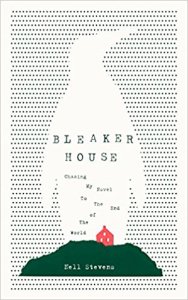 Bleaker House: Chasing My Novel to the End of the World by Nell Stevens is an account of her attempt to write a novel by living in the Falkland Islands for three months using funding from her Global Fellowship at the end of her creative writing course at Boston University. After arriving in Stanley where many of the 2,500 residents are based, she lived in self-imposed isolation on the uninhabited Bleaker Island for several weeks, believing that a total lack of distraction would be beneficial for her levels of creativity and productivity. For her stint on Bleaker Island, she had to pack all of her food supplies, restricting herself to just over 1,000 calories a day living mostly on instant porridge and Ferrero Rocher with just a copy of the film ‘Eat Pray Love’ on her laptop for company. Despite the unusual setting, Stevens’ experience of writing procrastination will resonate with anyone who has ever had an essay deadline to meet, even if her expectations and lack of preparation for some aspects of her trip are a tad infuriating in places. Extracts of her fiction are interspersed throughout and while these chapters are variable in quality and pad out what would otherwise be a very slim book, I think they are worth reading to get a sense of her creative output at the time. Overall, this is an interesting and often very funny account of a unique travel experience which proved to be inspiring for Stevens in the end, even if it wasn’t quite in the way she had initially bargained for. Continue reading
Filed under Books
You Think It, I’ll Say It by Curtis Sittenfeld
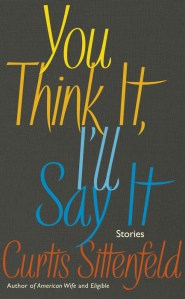 The blurb of ‘You Think It, I’ll Say It’ describes the unifying themes of Curtis Sittenfeld’s first collection of short stories as “how even the cleverest people tend to misread others, and how much we all deceive ourselves”. Specifically, the passing of time tends to distort the memories of the protagonists who are often flawed and naive, yet with just enough self-awareness to recognise these traits in themselves. This allows Sittenfeld’s natural gifts for convincing character portraits and satire (especially where class snobbery is concerned) to shine through in this contemporary collection. Continue reading
Filed under Books
Hotel du Lac by Anita Brookner
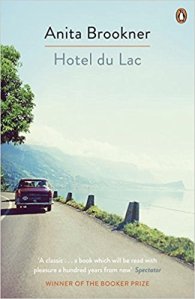 I haven’t read many of the early winners of the Booker Prize but ‘Hotel du Lac’ by Anita Brookner is one I have been meaning to read ahead of the Golden Man Booker Prize celebrations later this year. It tells the story of Edith Hope, a novelist of romantic fiction who is staying at a hotel near Lake Geneva in Switzerland by herself. A keen people-watcher, she has some unusual encounters with various eccentric guests including a rich widow Mrs Pusey and her daughter Jennifer, as well as Monica and her dog Kiki. However, it is Philip Neville, a divorced man also staying at the hotel who makes the most significant impression on the other guests. Continue reading
Filed under Books
Lullaby by Leïla Slimani
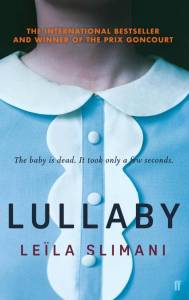 Winner of the prestigious Prix Goncourt and recently translated from the French by Sam Taylor, ‘Lullaby’ by Leïla Slimani has been one of the most talked-about novels so far this year, partly inspired by a real-life case of a nanny who killed two children in New York in 2012. Paul and Myriam live in a fashionable area of north-west Paris with their two young children, Mila and Adam. Paul works in the music business and Myriam is a criminal lawyer of North African descent who hires a nanny, Louise, to look after the children when she decides to resume her career. Initially, Louise appears to be perfect and indispensable to the family, but her behaviour becomes increasingly concerning. Continue reading
Filed under Books
4 3 2 1 by Paul Auster
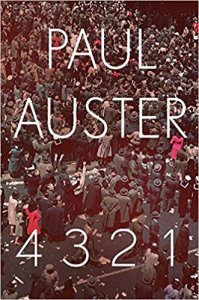 Shortlisted for the Man Booker Prize last year, ‘4 3 2 1’ by Paul Auster consists of four different versions of the life of Archibald Issac Ferguson, born in Newark, New Jersey in 1947 (the same year as Auster). Descended from Russian-Jewish immigrants, Archie is the only child of Rose and Stanley Ferguson and during his early childhood, random events change the path of his life splitting into four different trajectories – in one version his parents divorce, in another they stay together, in another Stanley dies, and so on. The parallel structure means that each of the seven parts is rewound three times before moving on to the next stage in Archie’s life covering his early childhood through to his coming-of-age in the late 1960s. Continue reading
Filed under Books
Rathbones Folio Prize: Q&A with Richard Lloyd Parry
Today I’m very pleased to host a Q&A with Richard Lloyd Parry who has been shortlisted for the Rathbones Folio Prize for his brilliant book Ghosts of the Tsunami – one of the best books I read in 2017. It is a narrative non-fiction account about the aftermath of the tsunami which devastated the east coast of Japan on 11th March 2011 and how it impacted a small community where many people lost their lives. I’m very pleased that this riveting book has recently been shortlisted for the Rathbones Folio Prize – a relatively new literary award in which 60 fiction and non-fiction books are nominated by members of the Folio Academy and then whittled down to a shortlist of eight. This year’s list also includes two novels I have read and enjoyed very much: Conversations with Friends by Sally Rooney and Reservoir 13 by Jon McGregor.
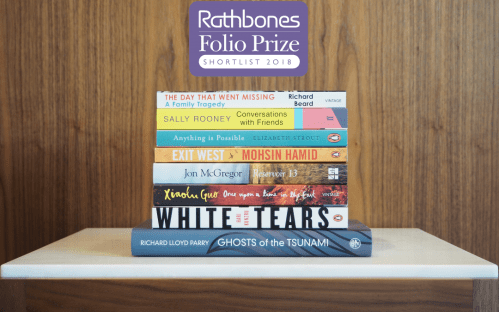
Q&A with Richard Lloyd Parry
1. At what age did you know you wanted to become a writer?
Eighteen. I thought that wanted to direct plays, but brief experience at university made me realise how dependent theatre is on the temperamental peculiarities of other people. I prefer to work alone, or in a small team. Continue reading
Comments Off on Rathbones Folio Prize: Q&A with Richard Lloyd Parry
Filed under Books
The Butchering Art by Lindsey Fitzharris
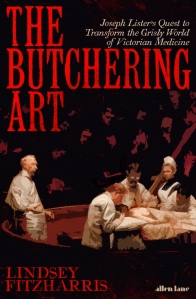 My final Wellcome Book Prize shortlist post is also part of the final day of the blog tour showcasing each book before the winner is announced tomorrow. ‘The Butchering Art: Joseph Lister’s Quest to Transform the Grisly World of Victorian Medicine’ by Lindsey Fitzharris is one of the titles I was particularly interested in reading when the longlist was announced in February. Although Lister is the main biographical subject of the book, ‘The Butchering Art’ also works as a more general narrative non-fiction account of the history of surgery in the mid 19th century. Continue reading
Filed under Books
Sight by Jessie Greengrass
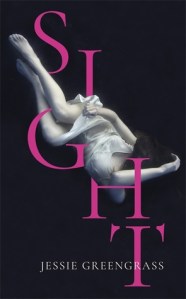 I haven’t yet finished shadowing this year’s Wellcome Book Prize shortlist but I have already come across a novel which has very strong potential to be on next year’s longlist of books which engage in some aspect of health, illness or medicine. I enjoyed reading Jessie Greengrass’s collection of short stories An Account of the Decline of the Great Auk, According to One Who Saw It and her debut novel tells the story of an unnamed narrator who is expecting her second child with her partner, Johannes. During her pregnancy, she reflects on her relationships with her mother who she cared for during her terminal illness and her psychoanalyst grandmother known as “Doctor K”. Continue reading
Filed under Books
The Vaccine Race by Meredith Wadman
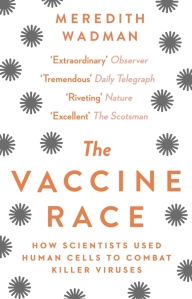 ‘The Vaccine Race: How Scientists Used Human Cells to Combat Killer Diseases’ by Meredith Wadman is an account of the history, science and ethics of vaccine development in the United States. It primarily concerns the career of American anatomy professor Leonard Hayflick and his quest to find and mass produce the safest human cells for use in vaccines at a time when viruses such as polio and rubella were far more prevalent than they are today. Continue reading
Filed under Books
With the End in Mind by Kathryn Mannix
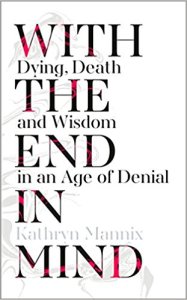 ‘With the End in Mind: Dying, Death and Wisdom in an Age of Denial’ by Dr Kathryn Mannix is a collection of anonymised patient case studies (or “stories” as Mannix calls them) drawn from her thirty years of experience as a palliative care clinician and consultant. It has been shortlisted for this year’s Wellcome Book Prize which I am shadowing with fellow book bloggers Rebecca, Laura, Annabel and Paul and is notably similar to one of the previous winners It’s All In Your Head by Suzanne O’Sullivan in that it seeks to demystify one of the most misunderstood aspects of medicine. In this case, it is death – the event that we will all one day meet (unless the transhumanists Mark O’Connell wrote about in To Be a Machine have their way…).
Continue reading
Filed under Books
Mayhem by Sigrid Rausing
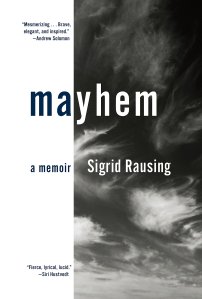 Shortlisted for the Wellcome Book Prize, ‘Mayhem’ is Sigrid Rausing’s family memoir about drug addiction. Her younger brother and heir to the Tetra Pak fortune, Hans Kristian, met American businesswoman, Eva Kemeny, when they were in rehab together in the late 1980s. They later married and became well-known philanthropists based in London. However, they relapsed and in 2007, Sigrid was granted custody of Hans and Eva’s four children. In July 2012, Hans was stopped by the police after driving erratically through London and was found with drugs in his possession. When the police searched his Belgravia mansion, they discovered Eva’s remains hidden under a mattress. She had been dead for approximately two months. Continue reading
Filed under Books
To Be a Machine by Mark O’Connell
Over the next few weeks, I will be shadowing the Wellcome Book Prize shortlist with fellow book bloggers Rebecca, Laura, Annabel and Paul. The £30,000 prize is awarded to a book about any aspect of health, medicine or illness and this year’s six shortlisted titles are: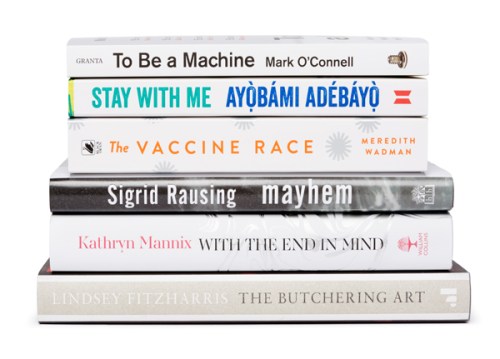
I read and reviewed the only fiction title Stay With Me last year which leaves the five non-fiction titles to read over the next few weeks. First up is ‘To Be a Machine: Adventures Among Cyborgs, Utopians, Hackers, and the Futurists Solving the Modest Problem of Death’ by Mark O’Connell which was also shortlisted for the Baillie Gifford Prize for Non-Fiction last year. While most of the books on the Wellcome Book Prize shortlist deal with illness, ‘To Be a Machine’ is more about what it is to be human or “post-human” in which O’Connell, a freelance journalist, explores the transhumanist movement which is “predicated on the conviction that we can and should use technology to control the future evolution of our species” (p.2) and advocates “nothing less than a total emancipation from biology itself” (p.6). In other words, transhumanists want to eliminate ageing as a cause of death. Continue reading
Filed under Books
Asymmetry by Lisa Halliday
 ‘Asymmetry’ by Lisa Halliday consists of two seemingly unrelated stories which are eventually revealed to have surprising connections. The first part, ‘Folly’, concerns Alice, an editorial assistant in her twenties living in post 9/11 New York City who begins a relationship with a much older man, a Jewish author named Ezra Blazer who has repeatedly been overlooked for a Nobel Prize for Literature. In the second part, ‘Madness’, an Iraqi-American economist, Amar Jaafari, is on his way to Kurdistan to visit his brother but is detained by immigration officials at Heathrow Airport. Continue reading
Filed under Books
The Man Booker International Prize Longlist 2018
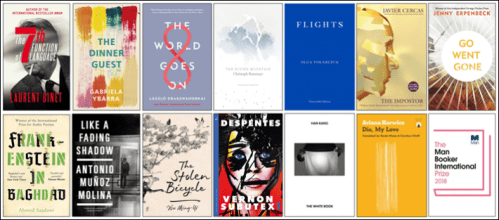
The Man Booker International Prize 2018 longlist was announced yesterday. The 13 books are:
The 7th Function of Language by Laurent Binet, translated by Sam Taylor
The Impostor by Javier Cercas, translated by Frank Wynne
Vernon Subutex 1 by Virginie Despentes, translated by Frank Wynne
Go, Went, Gone by Jenny Erpenbeck, translated by Susan Bernofsky
The White Book by Han Kang, translated by Deborah Smith
Die, My Love by Ariana Harwicz, translated by Sarah Moses and Carolina Orloff
The World Goes On by László Krasznahorkai, translated by John Batki, Ottilie Mulzet and George Szirtes
Like a Fading Shadow by Antonio Muñoz Molina, translated by Camilo A Ramirez
The Flying Mountain by Christoph Ransmayr, translated by Simon Pare
Frankenstein in Baghdad by Ahmed Saadawi, translated by Jonathan Wright
Flights by Olga Tokarczuk, translated by Jennifer Croft
The Stolen Bicycle by Wu Ming-Yi, translated by Darryl Sterk
The Dinner Guest by Gabriela Ybarra, translated by Natasha Wimmer
Filed under Books
The Man Booker International Prize 2018 Longlist Predictions
 Although I’m not participating in the shadow panel this year, I have been thinking about possible contenders for this year’s Man Booker International Prize longlist which is due to be announced tomorrow. My predictions last year were very wide off the mark – maybe this year I will manage more than one…
I have read a handful of eligible titles in recent months but I have only reviewed a couple of them on my blog:
Women Who Blow on Knots by Ece Temelkuran (translated from the Turkish by Alexander Dawe) – this is a book which has garnered increasing attention. I’m less sure about its shortlist chances – the plotting is a bit all over the place – but its topical themes contrast strongly with what is still likely to be a longlist dominated by male authors.
Men Without Women by Haruki Murakami (translated from the Japanese by Philip Gabriel and Ted Goossen) – short story collections are eligible as well as novels, although none have been longlisted so far. I enjoyed Murakami’s latest offering a lot and a place on the longlist would certainly help boost the profile of the Prize. Continue reading
Filed under Books
The Women’s Prize for Fiction Longlist 2018
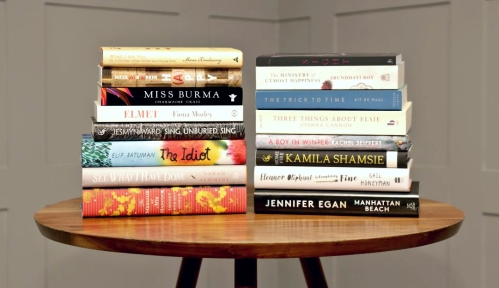
The Women’s Prize for Fiction longlist has been announced today. The 16 titles are:
H(A)PPY by Nicola Barker
The Idiot by Elif Batuman
Three Things About Elsie by Joanna Cannon
Miss Burma by Charmaine Craig
Manhattan Beach by Jennifer Egan
The Mermaid and Mrs Hancock by Imogen Hermes Gowar
Sight by Jessie Greengrass
Eleanor Oliphant is Completely Fine by Gail Honeyman
When I Hit You: Or, A Portrait of the Writer as a Young Wife by Meena Kandasamy
Elmet by Fiona Mozley
The Ministry of Utmost Happiness by Arundhati Roy
See What I Have Done by Sarah Schmidt
A Boy in Winter by Rachel Seiffert
Home Fire by Kamila Shamsie
The Trick to Time by Kit de Waal
Sing, Unburied, Sing by Jesmyn Ward
Filed under Books
Jewish Book Week: Adam Kay and Rachel Clarke / Francesca Segal and Amanda Craig
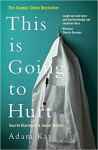


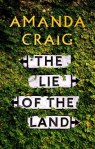
On Sunday, I attended two Jewish Book Week events at Kings Place in London. The first was Adam Kay and Rachel Clarke in conversation with Daniel Glaser about their experiences as NHS junior doctors and the second was a discussion with novelists Francesca Segal and Amanda Craig chaired by Claire Armitstead.
‘This is Going to Hurt: Secret Diaries of a Junior Doctor’ is based on Adam Kay’s experiences working in NHS hospitals from 2004 to 2010 specialising in obstetrics and gynaecology. It’s fair to say his book isn’t for the squeamish reader – the “degloving” incident is among the most memorable as is the Kinder Surprise story which Kay also read out loud to the audience. The title is apt – much of it is painfully funny while other parts are achingly sad and the ending in particular comes as an abrupt shock. Kay decided not to continue his medical career as a result of this tragic incident and it was the junior doctors’ strike years later in 2016 which compelled him to share his experiences. Kay and Clarke agreed that the term “junior doctor” is unhelpful – it implies someone in their early 20s straight out of medical school but it also applies to doctors on the verge of becoming consultants with multiple postgraduate qualifications and many years of experience. Continue reading
Filed under Books
The Women’s Prize for Fiction 2018 Longlist Predictions
 The Women’s Prize for Fiction longlist is due to be announced on Thursday 8th March and I have been thinking about which books could make the cut. My predictions last year included the eventual winner The Power by Naomi Alderman which is satisfying but I also hope to be pleasantly surprised by the inclusion of some novels which are new to me.
For many years, there have been 20 titles on the longlist. However, there were supposed to be only 12 last year but the judges decided to increase their selection to 16. This year – who knows? Novels first published in the UK between 1st April 2017 and 31st March 2018 are eligible. Of those I have read, I would be particularly happy to see any of the following on the longlist:
Little Fires Everywhere by Celeste Ng – I really enjoyed this excellent novel set in Shaker Heights, Ohio in the 1990s which addresses adoption, abortion and surrogacy.
Elmet by Fiona Mozley – last year’s Man Booker Prize dark horse blends ancient folklore and dialect with modern settings and political debates. Continue reading
Filed under Books



 A Little Blog of Books
You must be logged in to post a comment.