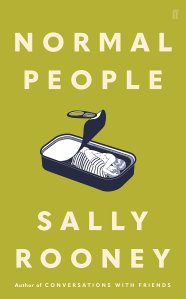
 ‘Normal People’ by Sally Rooney tells the story of teenagers Marianne Sheridan and Connell Waldron who go to school together in the small rural town of Carricklea in the west of Ireland and later move to Dublin to study at Trinity College in the early 2010s. Marianne is a loner from a well-off family while Connell is popular at school and their romance is kept secret from their classmates. However, Marianne finds friends easily among their privileged contemporaries at university whereas Connell feels alienated, and this sudden reversal in their social status complicates their relationship. Continue reading
Tag Archives: Fiction
Normal People by Sally Rooney
Filed under Books
We Have Always Lived in the Castle by Shirley Jackson
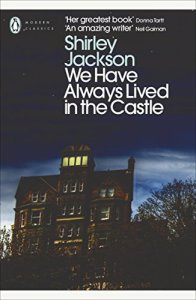 I enjoyed reading The Haunting of Hill House by Shirley Jackson last year and her final novel ‘We Have Always Lived in the Castle’ published in 1962 three years before Jackson’s death tells the story of eighteen-year-old Mary Katherine “Merricat” Blackwood who lives with her older sister, Constance, and their uncle, Julian, on a large secluded estate in New England. Six years earlier, half of the Blackwood family including Merricat and Constance’s parents were poisoned when the sugar bowl used at dinner was laced with arsenic. Although Constance was acquitted of the murders, the three surviving Blackwoods remain isolated from the rest of their small village. However, the arrival of their cousin Charles threatens their future and Merricat becomes increasingly suspicious of the real reason why he has suddenly turned up out of the blue. Continue reading
Filed under Books
Snap by Belinda Bauer
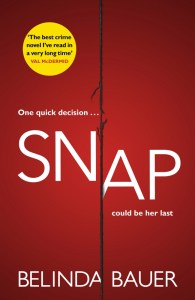 The opening chapter of ‘Snap’ by Belinda Bauer presents a chilling premise based on the unsolved murder of Marie Wilks. On a hot day in the summer of 1998, eleven-year-old Jack Bright is left in a broken-down car by the side of a motorway with his two younger sisters, Joy and Merry, while their pregnant mother, Eileen, goes in search of a telephone for help. However, she never returns and her body is eventually found stabbed to death.
Three years later and abandoned by their father who was unable to cope, Jack turns to burgling houses to provide for his sisters and escape being noticed by social services. On the other side of town, a young pregnant woman, Catherine While, discovers a knife next to her bed with a note that reads “I could have killed you” but she decides not to tell her husband about the break-in or report it to the police. Elsewhere, DS Reynolds who does everything by the book and DCI Marvel who takes a slightly more unorthodox approach towards detective work are investigating multiple burglaries and the identity of Eileen’s killer who still hasn’t been caught and are in a race against time to solve both mysteries. Continue reading
Filed under Books
Flights by Olga Tokarczuk
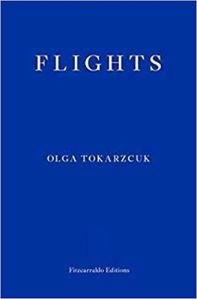 I have recently read this year’s winner of the Man Booker International Prize ‘Flights’ by Olga Tokarczuk which was first published in Poland back in 2007 and has been translated by Jennifer Croft. I didn’t have time to shadow the MBIP last spring but as August is Women in Translation Month, this seemed like a good time to find out what to make of it. ‘Flights’ is about an unnamed woman and her reflections on travelling – and that’s about it as far as plot goes in this very fragmented book which can only be described as a “novel” in the loosest sense possible as it is more of a collection of thematically linked observations and vignettes. Continue reading
Filed under Books
Celebrating 100 Years of Muriel Spark
 2018 marks the centenary of Muriel Spark’s birth and I have recently read her autobiography ‘Curriculum Vitae’ and one of her most famous novels ‘The Driver’s Seat’ which was first published in 1970. The main protagonist, Lise, is in her mid-thirties and is unhappy with her dead-end job. She hops on a plane to an unnamed southern European city looking for adventure and has a series of odd interactions with even odder people she meets along the way. Spark ingeniously drops a massive spoiler at the beginning of the third chapter in which it is casually stated that Lise “will be found tomorrow morning dead from multiple stab-wounds, her wrists bound with a silk scarf and her ankles bound with a man’s necktie, in the grounds of an empty villa, in a park of the foreign city to which she is travelling on the flight now boarding at Gate 14.” The narrative then continues as if this information had never been mentioned and the mystery of who the perpetrator is and how and why the murder occurs isn’t revealed until the final paragraphs. Continue reading
Filed under Books
The Heart’s Invisible Furies by John Boyne
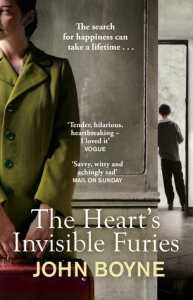 ‘The Heart’s Invisible Furies’ by John Boyne is a 700 page epic novel about the life of a gay man, Cyril Avery, which also encompasses the social history of Ireland in the second half of the 20th century. The story is told in seven-year increments, starting with the circumstances leading up to Cyril’s birth in Dublin in August 1945 to an unmarried teenage mother, Catherine Goggin, right up until the year when Ireland legalised same-sex marriage by public vote in 2015. Cyril is adopted as a baby by novelist Maude Avery and her banker husband Charles who uses every opportunity to remind Cyril that he is “not a real Avery” with the couple depriving him of any real affection. During adolesence and beyond, Cyril has an unrequited crush on his best friend, Julian Woodbead, and this experience shapes the rest of his life as he struggles to be honest with other people and with himself. Continue reading
Filed under Books
The Man Booker Prize 2018 Longlist

The Man Booker Prize longlist for 2018 has been announced today (officially this time – it seems it was accidentally leaked by the Guardian yesterday afternoon). The 13 books are:
Snap by Belinda Bauer
Milkman by Anna Burns
Sabrina by Nick Drnaso
Washington Black by Esi Edugyan
In Our Mad and Furious City by Guy Gunaratne
Everything Under by Daisy Johnson
The Mars Room by Rachel Kushner
The Water Cure by Sophie Mackintosh
Warlight by Michael Ondaatje
The Overstory by Richard Powers
The Long Take by Robin Robertson
Normal People by Sally Rooney
From a Low and Quiet Sea by Donal Ryan Continue reading
Filed under Books
The Man Booker Prize 2018 Longlist: Predictions, Possibilities and Preferences
 The Man Booker Prize longlist will be announced on Tuesday 24th July and the annual guessing game of “posh bingo” commences once again. When considering which books could make the cut, I have been thinking about predictions in terms of likely possibilities and my personal preferences – some I have already read, and some I haven’t. I doubt I will better my predictions last year in which I correctly guessed six out of the 13 “Man Booker dozen” longlisted titles including the eventual winner Lincoln in the Bardo by George Saunders. As ever, I have no knowledge of which books have actually been submitted for consideration so my predictions could just as easily be entirely wrong this time.
I would be surprised if the longlist was as dominated by established authors as it was last year. However, Winter by Ali Smith remains a stand-out preference for me, even if the judges decide to plump for something different following Autumn being shortlisted just last year. Another possibility is The Sparsholt Affair by Alan Hollinghurst about a sex scandal involving students at Oxford University during the Blitz and the consequences this has for their families years down the line. Continue reading
Filed under Books
How to Be Human by Paula Cocozza
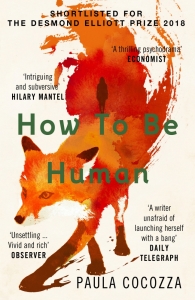
Shortlisted for this year’s Desmond Elliott Prize awarded to debut novels published in the UK, ‘How to Be Human’ by Paula Cocozza tells the story of Mary Green, a woman in her thirties who has recently separated from her partner Mark. Now living alone after buying him out of their home in Hackney in east London, she becomes captivated by an urban fox who regularly visits her garden. Meanwhile, her next door neighbours, Michelle and Eric, regard her new visitor as a pest while Mark makes an unwelcome return into her life. Continue reading
Filed under Books
The Song of Achilles by Madeline Miller
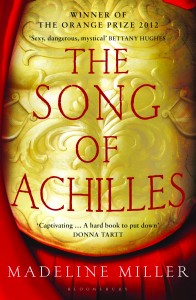 ‘The Song of Achilles’ by Madeline Miller is a modern retelling of ‘The Iliad’ and won the Women’s Prize (then Orange Prize) for Fiction in 2012. Whereas Homer’s epic was told from the perspective of demi-god Achilles as the warrior hero of ancient Greece, it is the exiled prince Patroclus who takes centre stage here, having been a minor character in the original. In Miller’s interpretation of events, Achilles and Patroclus are inseparable childhood friends who later become lovers, and when the time comes for Achilles to fulfil his destiny, Patroclus follows him to war with the Trojans. Continue reading
Filed under Books
Man Booker Prize: The Best of the Shortlists
 The Man Booker Prize is celebrating its 50th anniversary this year with a “best of the best” Golden Man Booker Prize due to be awarded next month. However, while the winning novels have often been met by a mixed response, many of the shortlisted and longlisted titles have been well received and in some cases go on to be better known than those taking the prize that year. So if the past winners don’t inspire you, then here is a selection of “the best of the rest” to consider.
His Bloody Project by Graeme Macrae Burnet – shortlisted in 2016, this is a brilliantly original historical crime novel which blurs the line between fiction and non-fiction with outstanding results. Published by Saraband, a small Scottish independent press, I doubt I would have discovered this if it hadn’t been for the publicity generated by the Man Booker Prize. Continue reading
Filed under Books
You Think It, I’ll Say It by Curtis Sittenfeld
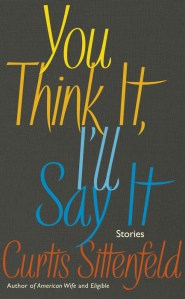 The blurb of ‘You Think It, I’ll Say It’ describes the unifying themes of Curtis Sittenfeld’s first collection of short stories as “how even the cleverest people tend to misread others, and how much we all deceive ourselves”. Specifically, the passing of time tends to distort the memories of the protagonists who are often flawed and naive, yet with just enough self-awareness to recognise these traits in themselves. This allows Sittenfeld’s natural gifts for convincing character portraits and satire (especially where class snobbery is concerned) to shine through in this contemporary collection. Continue reading
Filed under Books
Hotel du Lac by Anita Brookner
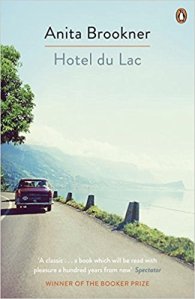 I haven’t read many of the early winners of the Booker Prize but ‘Hotel du Lac’ by Anita Brookner is one I have been meaning to read ahead of the Golden Man Booker Prize celebrations later this year. It tells the story of Edith Hope, a novelist of romantic fiction who is staying at a hotel near Lake Geneva in Switzerland by herself. A keen people-watcher, she has some unusual encounters with various eccentric guests including a rich widow Mrs Pusey and her daughter Jennifer, as well as Monica and her dog Kiki. However, it is Philip Neville, a divorced man also staying at the hotel who makes the most significant impression on the other guests. Continue reading
Filed under Books
Lullaby by Leïla Slimani
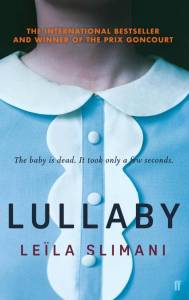 Winner of the prestigious Prix Goncourt and recently translated from the French by Sam Taylor, ‘Lullaby’ by Leïla Slimani has been one of the most talked-about novels so far this year, partly inspired by a real-life case of a nanny who killed two children in New York in 2012. Paul and Myriam live in a fashionable area of north-west Paris with their two young children, Mila and Adam. Paul works in the music business and Myriam is a criminal lawyer of North African descent who hires a nanny, Louise, to look after the children when she decides to resume her career. Initially, Louise appears to be perfect and indispensable to the family, but her behaviour becomes increasingly concerning. Continue reading
Filed under Books
4 3 2 1 by Paul Auster
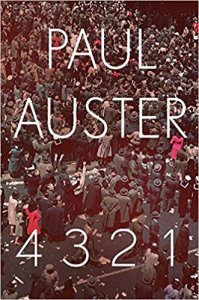 Shortlisted for the Man Booker Prize last year, ‘4 3 2 1’ by Paul Auster consists of four different versions of the life of Archibald Issac Ferguson, born in Newark, New Jersey in 1947 (the same year as Auster). Descended from Russian-Jewish immigrants, Archie is the only child of Rose and Stanley Ferguson and during his early childhood, random events change the path of his life splitting into four different trajectories – in one version his parents divorce, in another they stay together, in another Stanley dies, and so on. The parallel structure means that each of the seven parts is rewound three times before moving on to the next stage in Archie’s life covering his early childhood through to his coming-of-age in the late 1960s. Continue reading
Filed under Books
Sight by Jessie Greengrass
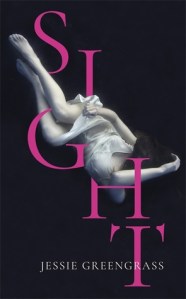 I haven’t yet finished shadowing this year’s Wellcome Book Prize shortlist but I have already come across a novel which has very strong potential to be on next year’s longlist of books which engage in some aspect of health, illness or medicine. I enjoyed reading Jessie Greengrass’s collection of short stories An Account of the Decline of the Great Auk, According to One Who Saw It and her debut novel tells the story of an unnamed narrator who is expecting her second child with her partner, Johannes. During her pregnancy, she reflects on her relationships with her mother who she cared for during her terminal illness and her psychoanalyst grandmother known as “Doctor K”. Continue reading
Filed under Books
The Vaccine Race by Meredith Wadman
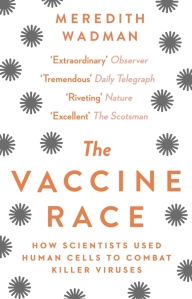 ‘The Vaccine Race: How Scientists Used Human Cells to Combat Killer Diseases’ by Meredith Wadman is an account of the history, science and ethics of vaccine development in the United States. It primarily concerns the career of American anatomy professor Leonard Hayflick and his quest to find and mass produce the safest human cells for use in vaccines at a time when viruses such as polio and rubella were far more prevalent than they are today. Continue reading
Filed under Books
Asymmetry by Lisa Halliday
 ‘Asymmetry’ by Lisa Halliday consists of two seemingly unrelated stories which are eventually revealed to have surprising connections. The first part, ‘Folly’, concerns Alice, an editorial assistant in her twenties living in post 9/11 New York City who begins a relationship with a much older man, a Jewish author named Ezra Blazer who has repeatedly been overlooked for a Nobel Prize for Literature. In the second part, ‘Madness’, an Iraqi-American economist, Amar Jaafari, is on his way to Kurdistan to visit his brother but is detained by immigration officials at Heathrow Airport. Continue reading
Filed under Books
The Man Booker International Prize 2018 Longlist Predictions
 Although I’m not participating in the shadow panel this year, I have been thinking about possible contenders for this year’s Man Booker International Prize longlist which is due to be announced tomorrow. My predictions last year were very wide off the mark – maybe this year I will manage more than one…
I have read a handful of eligible titles in recent months but I have only reviewed a couple of them on my blog:
Women Who Blow on Knots by Ece Temelkuran (translated from the Turkish by Alexander Dawe) – this is a book which has garnered increasing attention. I’m less sure about its shortlist chances – the plotting is a bit all over the place – but its topical themes contrast strongly with what is still likely to be a longlist dominated by male authors.
Men Without Women by Haruki Murakami (translated from the Japanese by Philip Gabriel and Ted Goossen) – short story collections are eligible as well as novels, although none have been longlisted so far. I enjoyed Murakami’s latest offering a lot and a place on the longlist would certainly help boost the profile of the Prize. Continue reading
Filed under Books
The Women’s Prize for Fiction Longlist 2018
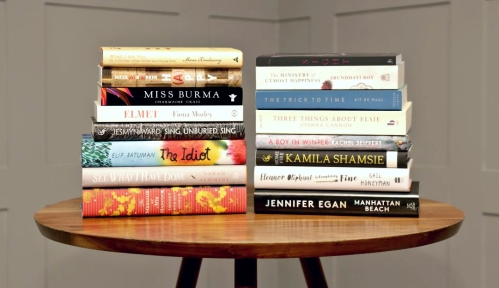
The Women’s Prize for Fiction longlist has been announced today. The 16 titles are:
H(A)PPY by Nicola Barker
The Idiot by Elif Batuman
Three Things About Elsie by Joanna Cannon
Miss Burma by Charmaine Craig
Manhattan Beach by Jennifer Egan
The Mermaid and Mrs Hancock by Imogen Hermes Gowar
Sight by Jessie Greengrass
Eleanor Oliphant is Completely Fine by Gail Honeyman
When I Hit You: Or, A Portrait of the Writer as a Young Wife by Meena Kandasamy
Elmet by Fiona Mozley
The Ministry of Utmost Happiness by Arundhati Roy
See What I Have Done by Sarah Schmidt
A Boy in Winter by Rachel Seiffert
Home Fire by Kamila Shamsie
The Trick to Time by Kit de Waal
Sing, Unburied, Sing by Jesmyn Ward
Filed under Books



 A Little Blog of Books
You must be logged in to post a comment.