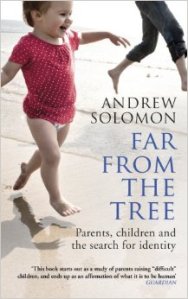
 Winner of the Wellcome Book Prize in 2014, ‘Far From the Tree: Parents, children and the search for identity’ is Andrew Solomon’s account of “ordinary people making courageous choices”. It is a densely written and detailed study which examines the links between identity and disability and the challenges faced by those perceived to be “different”. Divided into ten main topics, the first six (deaf, dwarfs, Down’s Syndrome, autism, schizophrenia, disability) focus on “horizontal” categories typically classified as illnesses, while the other four (prodigies, rape, crime, transgender) are “vertical” identities which are assumed to be socially constructed. Continue reading
Tag Archives: Reading
Far From The Tree by Andrew Solomon
Filed under Books
Man Booker International Prize 2016 Reviews
As the majority of the thirteen books longlisted for the Man Booker International Prize are novellas rather than novels, I finished reading all of them just after the shortlist was announced a couple of weeks ago. Here are my reviews of seven of the shorter books on the longlist:
 A Whole Life by Robert Seethaler translated from the German by Charlotte Collins has been shortlisted for the Prize and deservedly so. Even though it didn’t make it on to the shadow panel list, this book is one of my personal favourites and I would be very happy if it won the overall prize. It tells the story of Andreas Egger, a solitary man who lives in a remote mountain village in Austria during the twentieth century. The tone is very similar to that of Stoner by John Williams in that while Andreas lives a seemingly simple and quiet life, there are many events which have significant emotional repercussions for him. Seethaler succeeds in capturing “a whole life” in a spare but satisfying novella of just 150 pages.
Filed under Books
The Wellcome Book Prize 2016

Yesterday, I went to an event at the Wellcome Collection in London to hear the six authors nominated for this year’s Wellcome Book Prize discuss their shortlisted books. The annual award is open to works of fiction and non-fiction which engage with some aspect of health, illness or medicine, or “the ultimate human subject” as chair Anne Karpf said in her introduction.
The books on this year’s shortlist are:
- Signs for Lost Children by Sarah Moss
- The Last Act of Love by Cathy Rentzenbrink
- NeuroTribes by Steve Silberman
- Playthings by Alex Pheby
- It’s All in Your Head by Suzanne O’Sullivan
- The Outrun by Amy Liptrot
Filed under Books
Reading the World: Confessions of a Literary Explorer by Ann Morgan
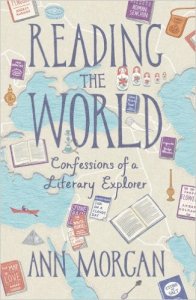 ‘Reading the World: Confessions of a Literary Explorer’ (also published under the title ‘The World Between Two Covers’ in the United States) is Ann Morgan’s account of how she read a book from every country in the world after realising that her literary diet mostly consisted of British and American authors. Rather than cobbling together Morgan’s reviews of the 197 books she read in 2012 which are already available for free on her excellent blog A Year of Reading the World, her bibliomemoir examines questions such as what makes a good translation, how to define a sovereign nation and what the future holds for world literature and the publishing industry. Continue reading
Filed under Books
The Man Booker International Prize Shortlist 2016
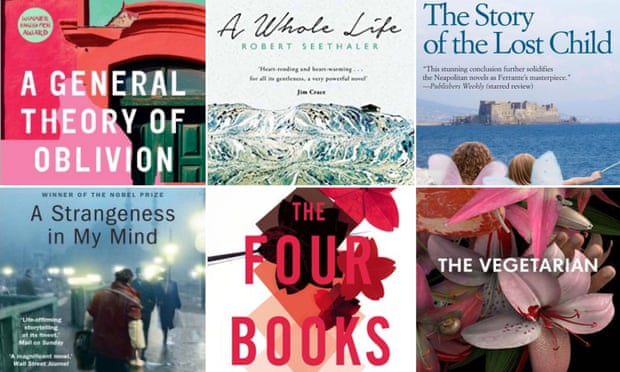
The official shortlist for the Man Booker International Prize was announced on Thursday. The six books are:
- A General Theory of Oblivion by José Eduardo Agualusa translated from the Portuguese by Daniel Hahn
- The Story of the Lost Child by Elena Ferrante translated from the Italian by Ann Goldstein
- The Vegetarian by Han Kang translated from the Korean by Deborah Smith
- The Four Books by Yan Lianke translated from the Chinese by Carlos Rojas
- A Strangeness in My Mind by Orhan Pamuk translated from the Turkish by Ekin Oklap
- A Whole Life by Robert Seethaler translated from the German by Charlotte Collins
Filed under Books
Death by Water by Kenzaburo Oe
 Translated from the Japanese by Deborah Boliver Boehm, ‘Death by Water’ by Kenzaburo Oe tells the story of Kogito Choko, an author aged in his 70s reflecting on his long career. For many years, he has struggled to write the “drowning” novel based on his father’s death shortly after the Second World War. Kogito returns to his rural home town to look at his father’s red leather trunk which his mother had instructed him not to open until ten years had passed after her death. However, it soon transpires that the contents of the trunk do not provide him with many answers, leaving Kogito limited time to unlock the secrets he needs to finish his book. Continue reading
Filed under Books
A Strangeness in My Mind by Orhan Pamuk
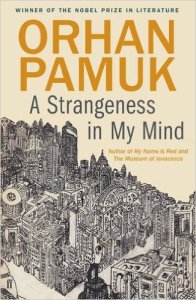 Translated from the Turkish by Ekin Oklap, ‘A Strangeness in My Mind’ by Orhan Pamuk tells the story of Mevlut Karata, a yoghurt and boza seller who lives in Istanbul. Melvut arrives in the city at the age of twelve in the late 1960s with his father from a poor village in Anatolia. He later elopes and marries Rayiha despite a case of mistaken identity in which he believed his love letters were being delivered to her sister. Over the course of four decades, he observes the political upheavals in the city and also experiences many personal challenges. Continue reading
Filed under Books
Four Other Books I’ve Read So Far in 2016
Here are some short reviews of a few other books I’ve been reading since Christmas:
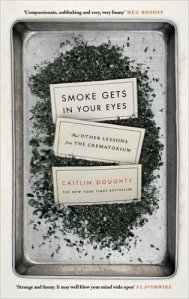 Smoke Gets in Your Eyes and Other Lessons from the Crematorium by Caitlin Doughty is an informative and thought-provoking memoir about the death industry written by a mortician seeking to demystify a taboo topic feared by almost everyone. Stories of burial practices, death rituals and cultural attitudes from around the world and throughout history are interwoven with Doughty’s personal experiences including the circumstances which led her to start working at Westwind Crematorium in San Francisco nearly a decade ago at the age of 23. Doughty’s sense of humour is appropriately dark without being disrespectful as she recounts some of her more memorable experiences at the crematorium and challenges readers to confront their own mortality. As much about life as it is about death, ‘Smoke Gets in Your Eyes’ is a fascinating look at a widely misunderstood career choice, although not a book I would recommend to the very squeamish or recently bereaved. Continue reading
Filed under Books
The Four Books by Yan Lianke
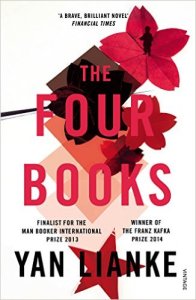 Translated from the Chinese by Carlos Rojas, ‘The Four Books’ by Yan Lianke is set in a labour camp in the ninety-ninth district near the Yellow River in north China where the Theologian, the Scholar, the Musician, the Author and other disgraced intellectuals are tasked with growing crops and smelting steel as part of their political “re-education”. The camp is led by a juvenile commander known as the Child who is also seeking approval from the “higher ups” in the party. However, as the economy fails and famine sets in, the inmates are left to survive on their own in appalling conditions. Continue reading
Filed under Books
The Vegetarian and Human Acts by Han Kang
 Longlisted for the Man Booker International Prize, ‘The Vegetarian’ by Han Kang and translated from the Korean by Deborah Smith tells the story of Yeong-hye who suddenly declares she will no longer eat meat after having a disturbing dream. Originally published as separate “novelettes”, the three parts of the story are told from the point of view of her husband, brother-in-law and sister respectively who are all outraged by her decision to become a vegetarian in a society where refusing to eat meat is extremely rare. Continue reading
Filed under Books
Dial M for Murdoch by Tom Watson and Martin Hickman and The Establishment by Owen Jones
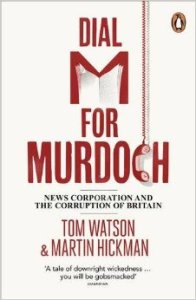 ‘Dial M for Murdoch: News Corporation and the Corruption of Britain’ by Tom Watson and Martin Hickman explores the background of the phone hacking scandal which engulfed Rupert Murdoch’s media empire News International. It was revealed in 2011 that messages on a mobile phone belonging to murdered teenager Milly Dowler had been hacked by journalists working for the News of the World, a former tabloid newspaper. The organisation initially used a “rogue reporter” defence but further evidence exposed how the practice had been carried out extensively for several years under the watch of several senior editors. This subsequently led to a complex investigation and public inquiry which implicated politicians and the police as much as the press. Continue reading
Filed under Books
Man Booker International Prize: Shadow Panel Official Response
 Following some early discussions this week, here is the shadow panel’s official response to the Man Booker International Prize longlist announced on Thursday:
“The Shadow Panel for the 2016 Man Booker International Prize congratulates the official judges on curating a longlist of thirteen fascinating titles, a selection containing many familiar names, but with enough surprise inclusions to keep us on our toes. We are particularly pleased about the geographical spread of the list; with seven of the thirteen books originating from outside Europe, the longlist has a truly global feel, which was certainly not the case with the final Independent Foreign Fiction Prize longlist. Continue reading
Filed under Books
The Man Booker International Prize Longlist 2016
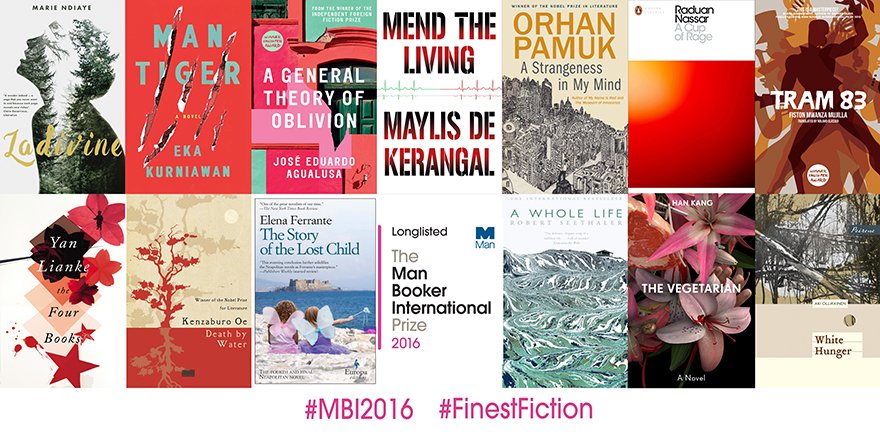
The longlist for the newly reconfigured Man Booker International Prize has been announced today. The thirteen books are:
- A General Theory of Oblivion by José Eduardo Agualusa (Angola), translated by Daniel Hahn and published by Harvill Secker.
- The Story of the Lost Child by Elena Ferrante (Italy), translated by Ann Goldstein and published by Europa Editions
- The Vegetarian by Han Kang (South Korea), translated by Deborah Smith and published by Portobello Books
- Mend the Living by Maylis de Kerangal (France), translated by Jessica Moore and published by Maclehose Press
- Man Tiger by Eka Kurniawan (Indonesia), translated by Labodalih Sembiring and published by Verso Books
- The Four Books by Yan Lianke (China), translated by Carlos Rojas and published by Chatto & Windus
- Tram 83 by Fiston Mwanza Mujila (Democratic Republic of Congo/Austria), translated by Roland Glasser and published by Jacaranda
- A Cup of Rage by Raduan Nassar (Brazil), translated by Stefan Tobler and published by Penguin Modern Classics
- Ladivine by Marie NDiaye (France), translated by Jordan Stump and published Maclehose Press
- Death by Water by Kenzaburō Ōe (Japan), translated by Deborah Boliner Boem (Atlantic Books)
- White Hunger by Aki Ollikainen (Finland), translated by Emily Jeremiah & Fleur Jeremiah and published by Peirene Press
- A Strangeness in My Mind by Orhan Pamuk (Turkey), translated by Ekin Oklap and published by Faber & Faber
- A Whole Life by Robert Seethaler (Austria), translated by Charlotte Collins and published by Picador
Filed under Books
The Baileys Women’s Prize for Fiction Longlist 2016
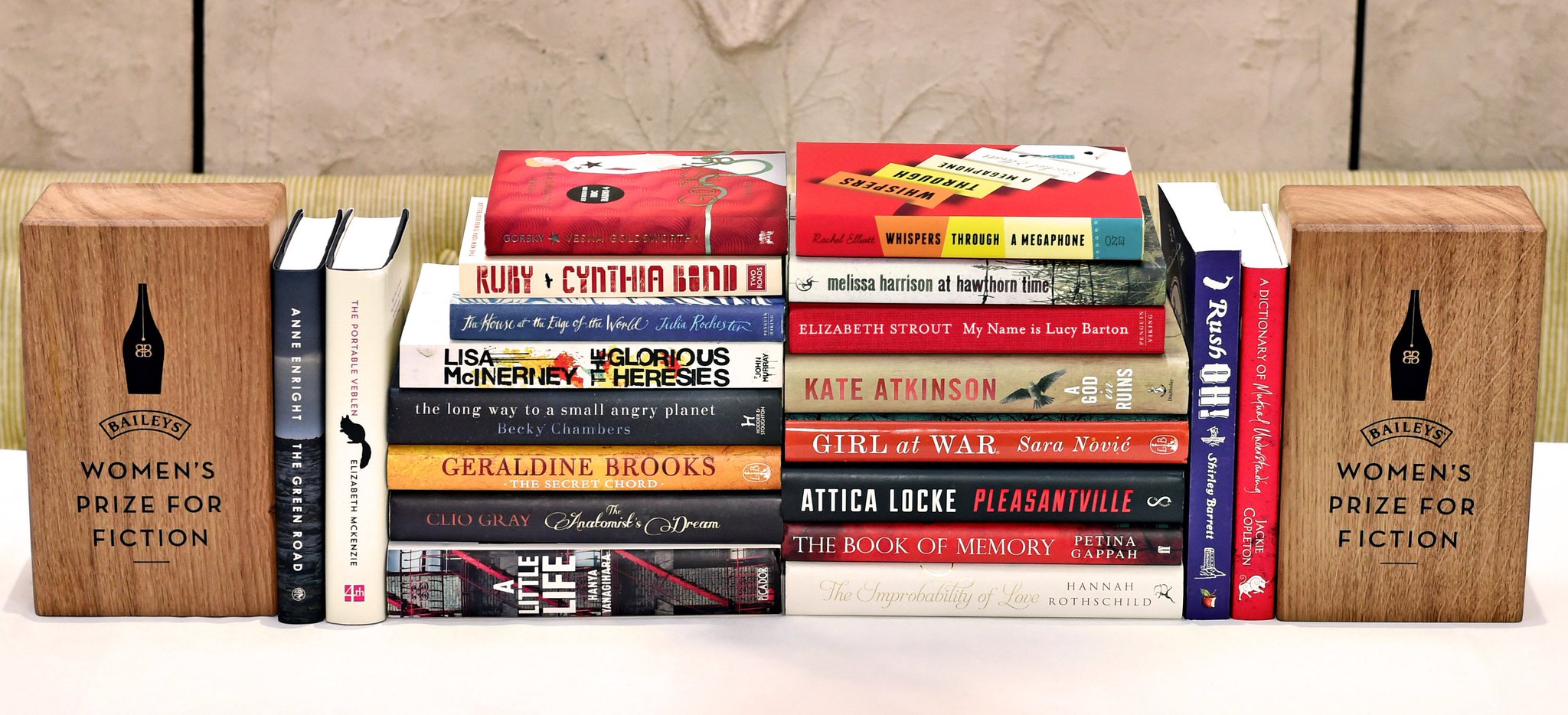
This year’s Baileys Women’s Prize for Fiction longlist was announced today. The twenty novels are:
A God in Ruins by Kate Atkinson Rush Oh! by Shirley Barrett Ruby by Cynthia Bond The Secret Chord by Geraldine Brooks The Long Way to a Small, Angry Planet by Becky Chambers A Dictionary of Mutual Understanding by Jackie Copleton Whispers Through a Megaphone by Rachel Elliott The Green Road by Anne Enright The Book of Memory by Petina Gappah Gorsky by Vesna Goldsworthy The Anatomist’s Dream by Clio Gray At Hawthorn Time by Melissa Harrison Pleasantville by Attica Locke The Glorious Heresies by Lisa McInerney The Portable Veblen by Elizabeth McKenzie Girl at War by Sara Nović The House at the Edge of the World by Julia Rochester The Improbability of Love by Hannah Rothschild A Little Life by Hanya YanagiharaFiled under Books
A God in Ruins by Kate Atkinson
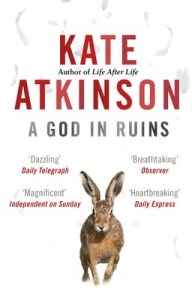 Kate Atkinson’s previous novel Life After Life published in 2013 told the story (or rather stories) of Ursula Todd who lives her life several times over in many variations with very different outcomes. Her latest book ‘A God in Ruins’ is a “companion novel” rather than a sequel which focuses on the life of Ursula’s younger brother Teddy. Spanning his life across the twentieth century and four generations of the Todd family, it draws on Teddy’s youth at Fox Corner, his wartime experiences as a pilot flying a Halifax bomber followed by later post-war years with his family. He marries his childhood sweetheart Nancy but has a strained relationship with their daughter Viola who shows little appreciation for the horrors Teddy witnessed when he served in Bomber Command. Continue reading
Filed under Books
Eileen by Ottessa Moshfegh
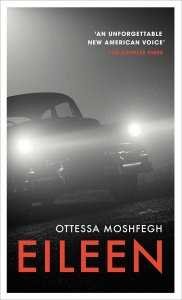 In 1964, the eponymous narrator of ‘Eileen’ by Ottessa Moshfegh is twenty-four years old, living with her alcoholic father and working as a secretary at a correctional facility for teenage boys. During the week leading up to Christmas, Eileen Dunlop is planning to disappear from her coastal Massachusetts home town which she names only as X-ville and start a new life in New York City. However, when she meets Rebecca Saint John, a new colleague at the correctional facility, events begin to take an unexpected turn. Continue reading
Filed under Books
The Good Liar by Nicholas Searle
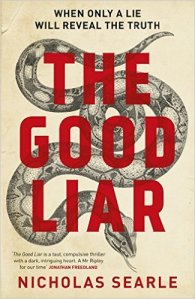 ‘The Good Liar’ by Nicholas Searle tells the story of Roy Courtnay, a conman aged in his eighties living in the leafy suburbs of England who is attempting to swindle wealthy widow Betty McLeish out of her life savings after meeting her on a dating website. However, although Betty appears to be a very easy target for Roy, she also appears to be suspiciously willing to become his latest victim.
I tend to look out for debut novels at the beginning of the year and ‘The Good Liar’ is one which I featured in my New Books Coming Soon in 2016 blog post last month. Stories about characters who live double lives are always intriguing, particularly when they have been written by an author like Searle who can reveal little about his own career as a senior civil servant dealing with security matters. Continue reading
Filed under Books
6 Translated Novellas I’ve Read Recently
With the Man Booker International Prize longlist announcement fast approaching on Thursday 10th March, here are some short works of translated fiction I’ve enjoyed recently:
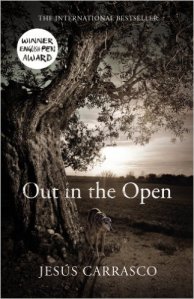 Translated from the Spanish by Margaret Jull Costa, Out in the Open by Jesús Carrasco has been widely compared to ‘The Road’ by Cormac McCarthy. Its unnamed central character is battling to survive in a desolate drought-ridden landscape. Having run away from home for reasons which are revealed towards the end, he strikes up an unlikely friendship with a goatherd. The absence of names for places and characters gives the book a timeless quality and although post-apocalyptic fiction has never been my favourite genre, Margaret Jull Costa’s excellent translation adds colour and depth to a very bleak story. Continue reading
Filed under Books
Sequels, Scriptwriting and Harry Potter and the Cursed Child
 It was announced on Wednesday that the script of ‘Harry Potter and the Cursed Child’ will be published on Sunday 31st July, the day after the world premiere of the new play in London’s West End. The publishers Little, Brown have confirmed that a special rehearsal edition of the script is being printed in response to massive public demand from fans around the world followed by a definitive collector’s edition at a later date. Set nineteen years after the Battle of Hogwarts, Harry Potter is now an “overworked employee of the Ministry of Magic” while his youngest son Albus “must struggle with the weight of a family legacy he never wanted”.
Filed under Books
In Cold Blood by Truman Capote
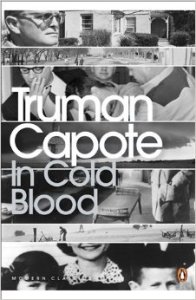 ‘In Cold Blood: A True Account of a Multiple Murder and Its Consequences’ by Truman Capote outlines the investigation into the murders of farmer Herb Clutter, his wife Bonnie and two of their teenage children at their home in Kansas in November 1959. After reading a short news article in the New York Times about the killings, Capote travelled to the small town of Holcomb with his friend, Harper Lee, where he undertook extensive research and interviewed hundreds of people who lived in the area or were involved in the case including the chief investigator, Alvin Dewey, and eventually the murderers themselves. Continue reading
Filed under Books



 A Little Blog of Books
You must be logged in to post a comment.